
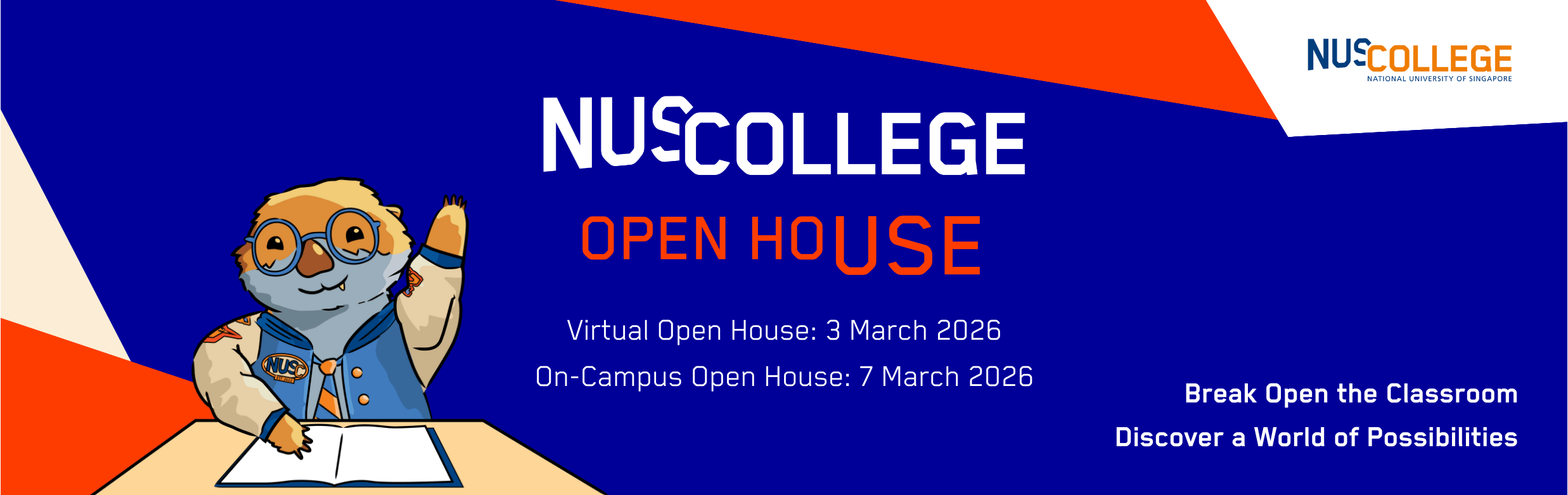
Come discover what learning can be and where it can take you at NUS College. Where we break open the classroom for our students to offer them more than an education, through our interdisciplinary curriculum, experiential global programmes and vibrant student residency with a diverse community. Join our Open House to learn more!
Find out what NUS College (NUSC) is all about! Discover our interdisciplinary curriculum, transformative global pathways programme and what it is like to live and learn in our residential community.
Meet our NUSC student ambassadors as they present intriguing teaser topics inspired by courses they have taken at NUSC. Come prepared to dive into the ideas, perspectives and conversations that will challenge the way you see the world.
At NUS College, we don’t just study subjects.
We explore big questions — across disciplines, across perspectives, across boundaries.
Find out what NUS College (NUSC) is all about! Discover our interdisciplinary curriculum, transformative global pathways programme and what it is like to live and learn in our residential community.
Hear firsthand from our NUSC student ambassador and alumni on how their NUSC experience shaped their career pathways, strengthened their adaptability, and prepared them to navigate real-world challenges with confidence.
Bring your questions, get candid insights, and discover how an interdisciplinary NUSC education equips you not just for your first job — but for a lifetime of possibilities.
Click on each time slot below to find out more.
Sample classes held at NUS College (Cendana) will have class sizes of up to 25 pax, similar to the class sizes in NUSC. Pre-registration is strongly encouraged, and walk-ins will only be accepted should pre-registered visitors not turn up by 10 minutes before the class starts.
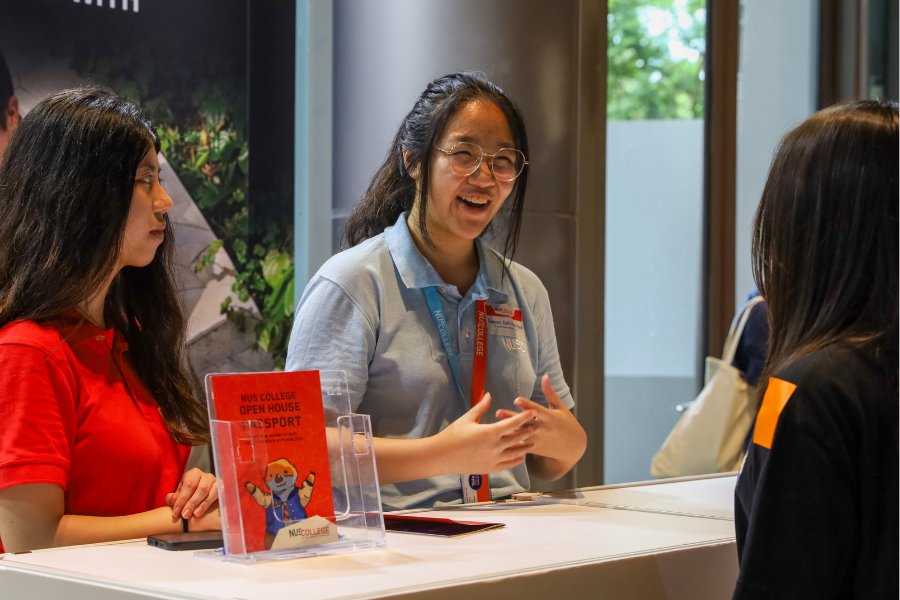

Venue: NUS College Multi-Purpose Hall & Oculus
Discover how NUSC offers more than an education from our student and staff team at our info-packed booths.

Venue: NUS College Multi-Purpose Hall & Elm-Library Foyer
Explore our impactful and purpose-filled experiential learning through the lenses of our students with their project showcase.
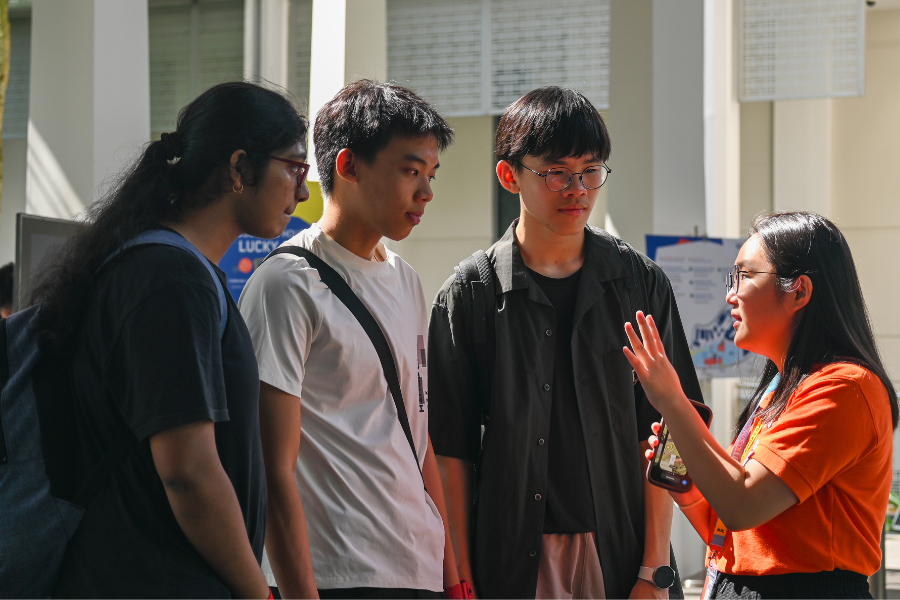
Venue: NUS College Multi-Purpose Hall & Oculus
Enjoy guided tours through our College by our Student Ambassadors! Available every 15min from 10am to 6.15pm.
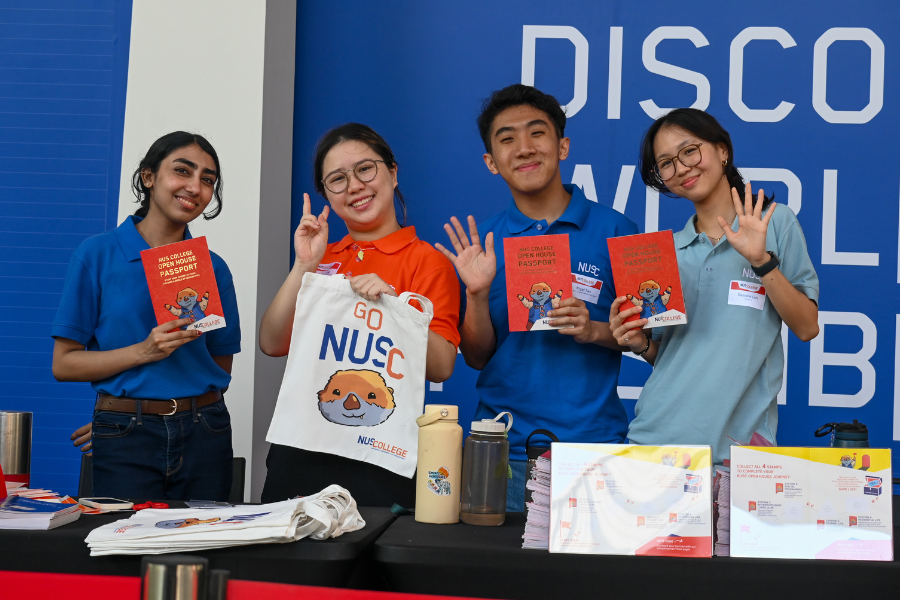
Venue: NUS College Multi-Purpose Hall & Oculus
Wonder how to get started or how’s life at NUSC? Have a chat with our faculty, staff and students at our Open House booths.
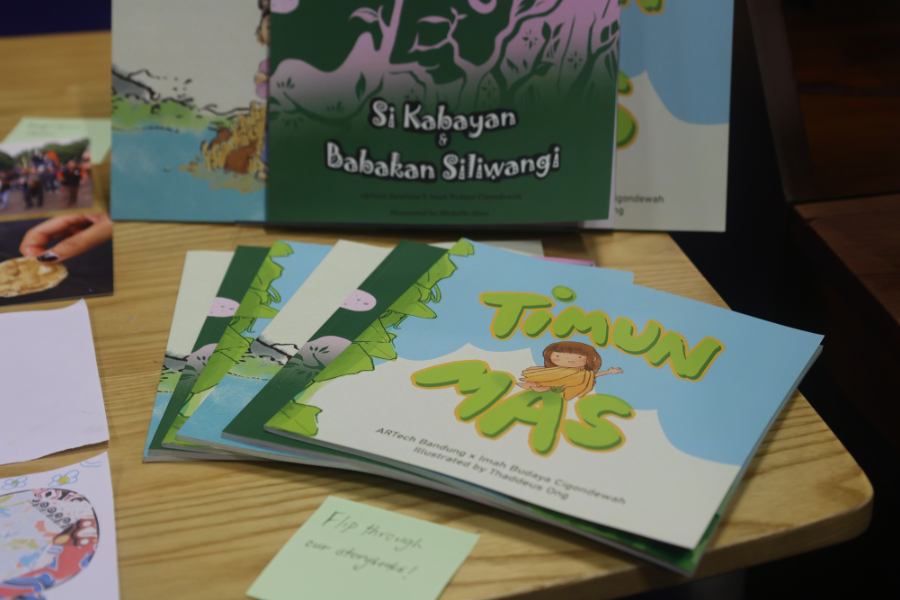
Venue: Education Resource Centre
Find out how NUSC Impact Experience projects by our faculty and students benefit individuals and communities.

What makes the NUS College education unlike any other? It’s what happens when we break open the classroom. Join our faculty and students as they reveal our robust interdisciplinary curriculum and transformative global pathways that makes NUSC unique to enrich your degree at NUS.
Walk-ins are welcome. Registration is not required.
Conducted by Associate Professor Seah Kar Heng
This sample class explores climate change, especially global warming due to burning fossil fuels and how switching to renewable energy can help alleviate the situation. Students will then explore how Singapore can contribute to this lofty goal.
About Associate Professor Seah Kar Heng
Associate Professor Seah Kar Heng obtained his B.Sc. First Class Honours in Mechanical Engineering in 1975 from the University of Southampton, U.K. on the Colombo Plan Scholarship as well as the President’s Scholarship. After completing his national service, he worked as a Mechanical Engineer in the Public Works Department. Subsequently, he obtained his M.Sc. And PhD. In Mechanical Engineering in 1980 and 1982 respectively, both from Queen’s University, Canada.
Conducted by Associate Professor Stuart Derbyshire
The paper cut is a paradox: a negligible injury that produces disproportionate pain. This sample class uses that paradox to ask, what is pain? By examining biology, psychology, and cultural expectations, we uncover why pain so often defies tidy scientific explanation.
Walk-ins are welcome. Registration is not required.
About Associate Professor Stuart Derbyshire
Broaden your horizons and experiences around the world through NUS College’s signature Global Pathways programme! Learn first-hand how we curate these unique out-of-classroom global experiences to shape your worldview and cultural understanding and contribute meaningfully towards your learning journey and life of purpose.
Walk-ins are welcome. Registration is not required.
Conducted by Dr Loo Yoke Leng
Is Harry Potter’s invisibility cloak fiction or reality? In this sample class, we will explore the science of invisibility through the concepts of ray tracing and the understanding of how we see objects around us. As part of the topic on invisibility cloaks, we will also discuss the impact on society if such an invention were to become a reality.
About Dr Loo Yoke Leng
Dr Loo Yoke Leng is a Lecturer, teaching Reasoning with Data, Science and Society at NUS College. She obtained her PhD in Physics from the National University of Singapore. Her research interest is in Metamaterials and Metadevices.
What makes the NUS College education unlike any other? It’s what happens when we break open the classroom. Join our faculty and students as they reveal our robust interdisciplinary curriculum and transformative global pathways that makes NUSC unique to enrich your degree at NUS.
Conducted by Dr Joel Chow
What is love? Most of us have some idea about what we think love is, but it also seems that our conceptions of love differ significantly. In this sample class, we examine our ideas about love through a philosophical and biological lens. We then close with a seemingly absurd question: can you love a chatbot?
Walk-ins are welcome. Registration is not required.
About Dr Joel Chow
Dr Joel Chow is a Senior Lecturer at NUS College. He obtained his PhD in Philosophy from the University of Arizona and his BA/PhB in Philosophy from NUS-The Australian National University Joint Honours Degree Programme. He is also an alumnus of the NUS University Scholars Programme (USP), graduating in the Class of 2011.
Conducted by Dr Bart Van Wassenhove
In this interactive sample class, we will discuss a famous thought experiment proposed by the philosopher Robert Nozick: would you enter a machine that provided you with a constant stream of pleasurable and interesting experiences, given that you could never leave? We will discuss your answers to this question and consider variations on Nozick’s thought experiment that may lead you to question your intuitions.
About Dr Bart Van Wassenhove
Conducted by Dr John Woon Rhym
This class gives you an idea of what NUS College’s flagship experiential programme, known as the Global Experience Programme, offers students in helping them understand themselves, their peers, and the place they will be immersed in for a month.
About Dr John Woon Rhym
Discover learning and living with diverse, brilliant minds within our vibrant NUS College community where students inspire and stretch one another. We’ll show you how our tight-knit community fulfils your curiosities and passions, while building lifelong bonds and courage and conviction needed to step up and act for the world.
Walk-ins are welcome. Registration is not required.
Conducted by Dr Norman Vasu
About Dr Norman Vasu
Dr Norman Vasu is the director of the Global Pathways Programme and Pillar Head of the Global Experience course at NUS College.
He is the author of Diasporas in Multiculturalism: Managing Difference (2004); co-author of Singapore Chronicles: Multiracialism (2018); editor of Social Resilience in Singapore: Reflections from the London Bombings (2007); and co-editor of Nations, National Narratives, and Communities in the Asia Pacific (2013), Immigration in Singapore (2014), and DRUMS Distortions, Rumours, Untruths, Misinformation, and Smears (2019).
He is a Fulbright Fellow, Arizona State University (2012); Senior Research Fellow, Takshashila Institution, India (2017), and Research Fellow, Daniel K Inouye Asian-Pacific Center for Security Studies (2018).
Conducted by Dr Philip Johns
Cats and dogs are organisms that have been associated with humans for thousands, even tens of thousands, of years. People often call themselves cat people or dog people. But are cats and dogs really so different? And if so, why? Why do we think of cats as mostly solitary animals and dogs as more social? Here, we explore what makes cats, cats and what makes dogs, dogs. We will examine their evolutionary history, their physical make-up and their behaviours to uncover the truth about cats and dogs.
About Dr Philips Johns
Dr Philip Johns is an Associate Professor at NUS College. His research interests revolve around the evolution and genetics of social behaviours in insects and other animals. He studies the behaviour, evolution, genetics and genomics of a group of Southeast Asian insects, stalk-eyed flies (Diopsidae), in both the field and laboratory. He has also studied the evolution of cooperation and eusociality in termites. Along the way he has studied everything from courtship and mating behaviour of mantises, to aggression and territoriality in spiders, to courtship in scorpions, to the songs of some very noisy crickets. He and his students study the social behaviours of an urban carnivore in Singapore, smooth-coated otters. He is especially interested in employing community science to conduct animal behaviour studies.
Conducted by Dr May Lim
How do computers organise information so quickly? This sample class explores simpler, smarter and faster ways to sort data, and comparing how different techniques solve the same problem.
About Dr May Lim
I am a computer scientist who obtained my PhD from NUS and my bachelor’s degree from NTU. Before starting my PhD, I worked in the tech industry and got to experience both start-up and multinational company environments. Currently, my research interests lie in the design of computer systems for video streaming. I am also teaching Computational Problem Solving and serving as an IEx supervisor in NUS College.
Conducted by Dr Christine Abigail Lee Tan
About Dr Christine Abigail Lee Tan
Dr Christine Abigail Lee Tan is a Filipino-born philosopher whose main areas of expertise are Chinese and Comparative Philosophy in general, and Neo-Daoist philosophy in particular. Before joining Yale-NUS College, she did her PhD at Nanyang Technological University in Singapore, where she wrote her dissertation titled ‘Freedom as Self-realisation: Zide in the Neo-Daoist Philosophy of Guo Xiang’. Before that, she did her MA and BA at the University of Santo Tomas, Philippines, where her areas of focus were psychoanalysis and post-structuralist philosophy.