
As part of NUS College’s Impact Experience two NUSC student teams, Shell-utions (Gili Islands) and Team Sabah Fish (Pulau Larapan) ventured beyond our classroom and shores into the heart of Southeast Asia to protect sea turtles and empower coastal communities. They returned with new skills, renewed conviction, and a deeper sense of purpose – shaped by the communities they worked alongside. Here’s a closer look at their journeys.
 Sunset over the Gili Islands, the backdrop to Shell-utions’ mission to protect its marine life. (Photo: Shell-utions
Shell-utions: Rescuing One Sea Turtle at a Time
Shell-utions, comprising a team of six NUSC students – Clare Lim, Ebelle Goh, Hsu Ching-Hsuan, Hwang Dowon, Jason Lee and Ngan Ka Fye, under the guidance of NUSC Instructor Ms Sam Shu Qin, entered the Gili Islands, Indonesia with a mission – to conserve sea turtles.
Their journey unfolded at a local turtle hatchery. There, the team watched first-hand how baby sea turtles were callously handled as a man tossed them from bucket to bucket with his bare hands.
“The baby turtles were crammed into buckets, each labelled with dates. An employee grabbed several at once and tossed them into another bucket so he could clean the first. It felt like watching someone wash vegetables rather than handle living animals,” offered Clare, hard hit by the truth.
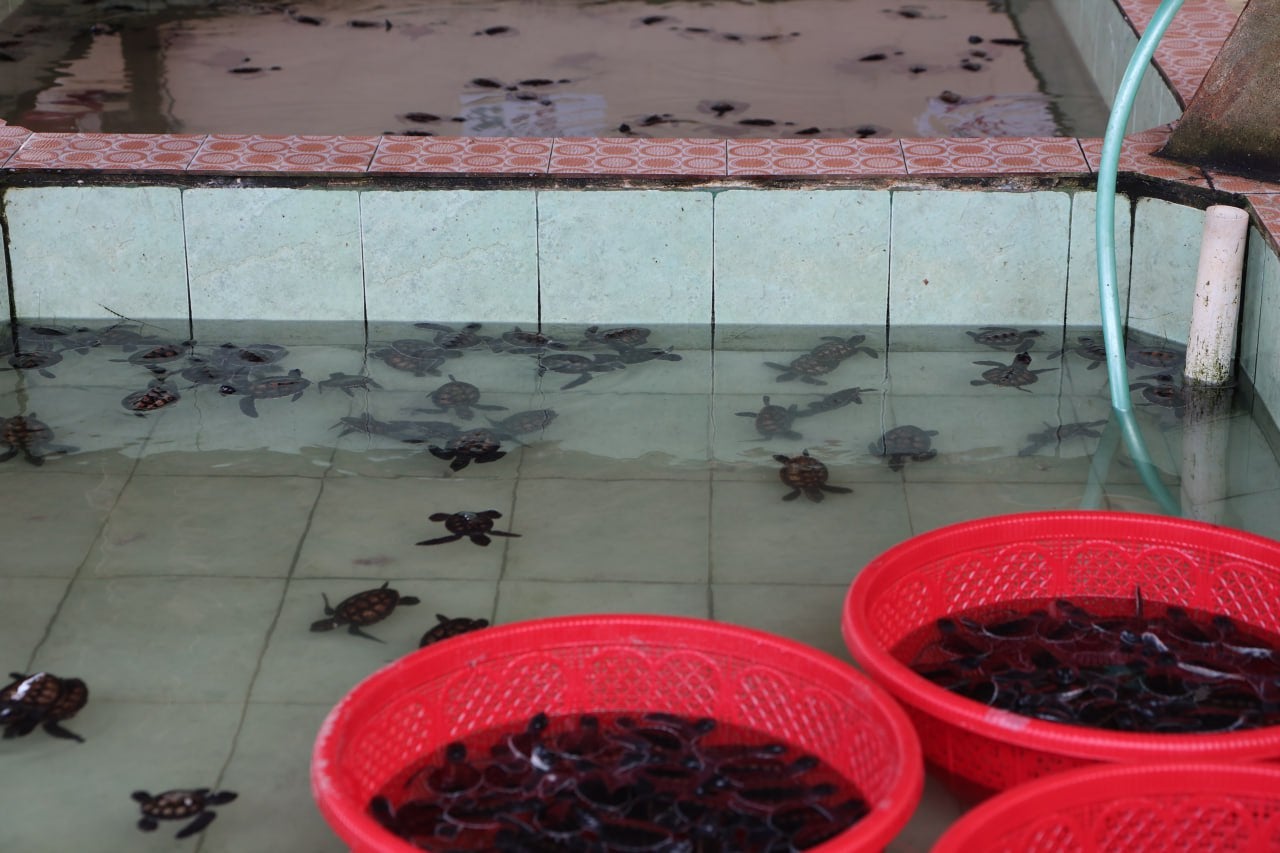 Baby turtles held in buckets at a hatchery. (Photo: Shell-utions)
Their instructor explained to them that such hatcheries – often marketed to tourists as conservation efforts – can do more harm than good. Hatchlings kept in buckets lose survival instincts developed in their earliest hours of life. Released in daylight instead of under the cover of moonlight, many fall prey to predators before they ever reach open water. What appears to be a heartfelt small business is, in reality, a tourist trap at the expense of the very animals it claims to protect.
It was that moment of truth which helped Shell-utions crystallise their project purpose: work with marine scientists to better understand and track turtle populations, while finding engaging, accessible ways to educate tourists and locals about proper turtle conservation.
The team’s brainchild involved building something that had never existed before: a social platform where divers and snorkellers could upload their underwater photos and videos, contribute to real conservation data and feel part of a community.
At the heart of the platform is an AI tool built on YOLO (You Only Look Once) and trained on over 1,400 labelled underwater images, capable of automatically identifying sea turtle species from uploaded footage. The team is also developing a 3D ArUco (Augmented Reality University of Córdoba) marker-based measurement system to estimate turtle body length from video, removing the need for manual measurement in the field entirely.
The data collected will then be shared with their partners, UNRAM (University of Mataram) and Marine Conservation ID – local researchers who have spent years trying to improve how turtle data is collected and managed in Southeast Asia.
Much of the scientific literature on marine conservation has long concentrated in Global North institutions, often behind paywalls and inaccessible to Southeast Asian researchers, even though these researchers know their ecosystems best. Shell-utions envisions shifting the knowledge balance, starting small by empowering their local partners with better data and building towards broader, international collaboration.
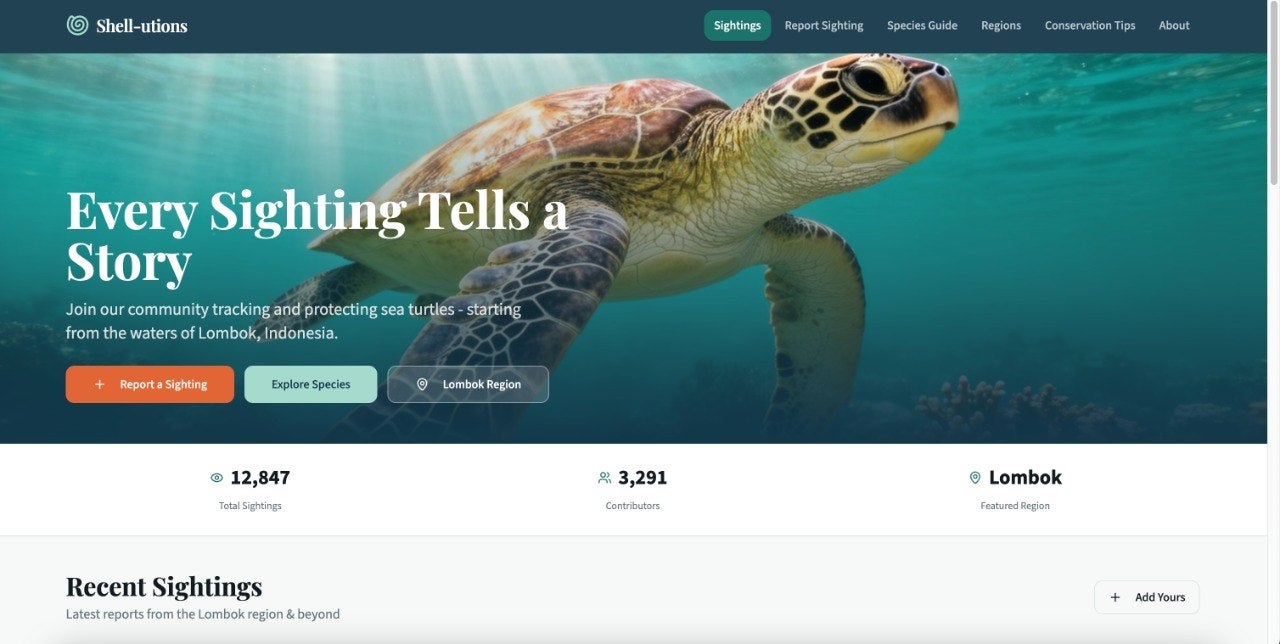 Shell-utions’ platform turns divers’ underwater encounters into valuable data for sea turtle conservation across the waters of Lombok, Indonesia. (Photo: Shell-utions)
For Shell-utions, the greatest challenge was a classic bootstrapping paradox. To filter the thousands of frames of underwater footage for turtle images, they needed a model – and building that model was precisely the challenge. There was no shortcut.
“We resolved it the hard way. Our team manually went over a thousand images to curate the data set by hand. It was tedious and time-consuming, but it was the necessary foundation that everything else was built on,” revealed Hwang Dowon.
Dowon also learnt something less technical but equally valuable: when to stop. There is a point in machine learning where adding more data or more training yields diminishing returns. Recognising that threshold and making a confident call to move forward rather than endlessly chasing a higher number was one of the most important lessons of the entire project. Good judgment, he noted, is knowing when something is good enough, not just knowing how to build it.
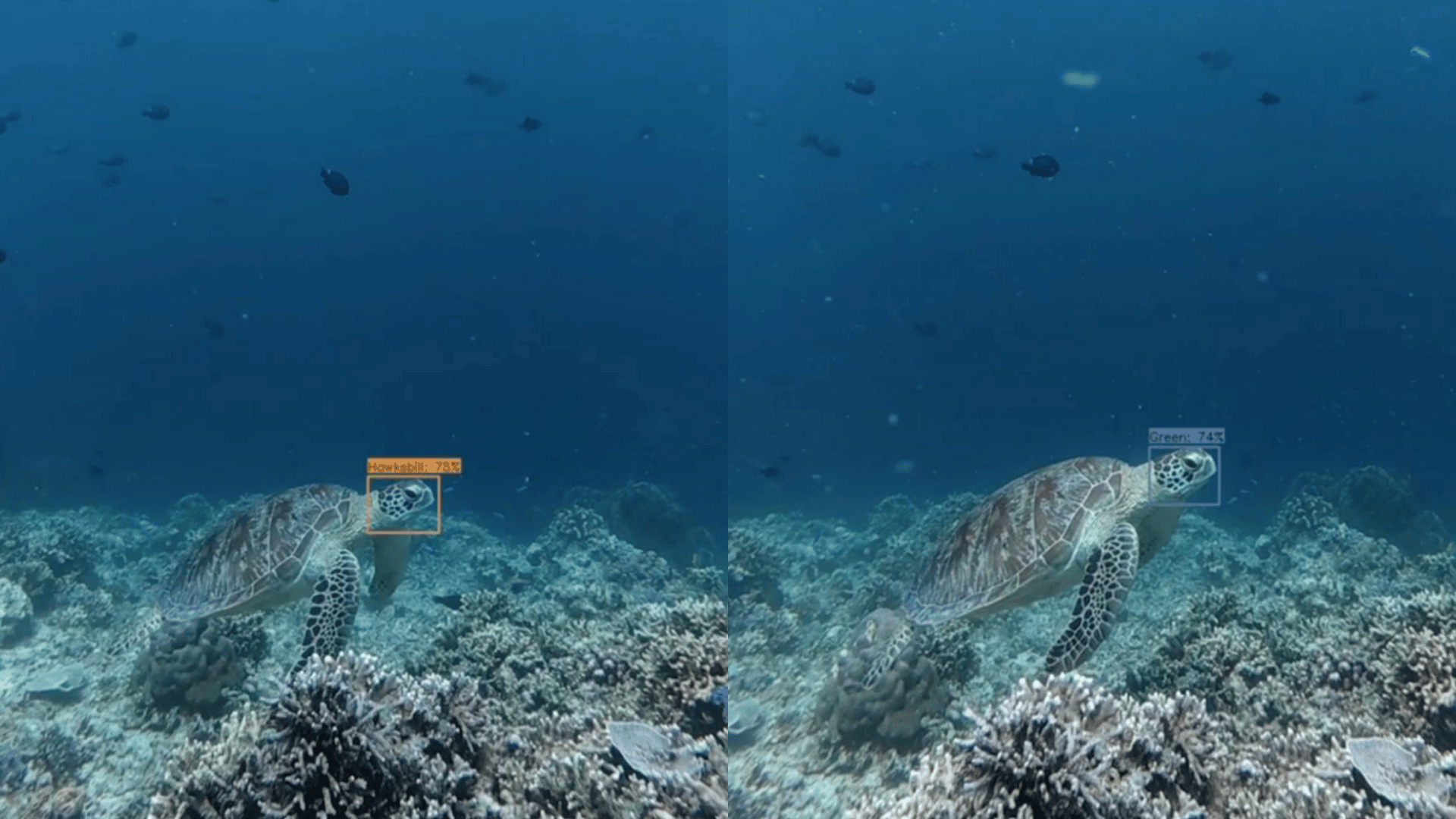 Shell-utions’ YOLO-powered platform identifies turtle species from diver footage. (Photo: Shell-utions)
Despite the odds, Shell-utions derives motivation from building a platform robust enough for researchers and divers to keep contributing to, ensuring that UNRAM and Marine Conservation ID have the data and tools to carry the conservation mission further.
“We hope Shell-utions becomes a tool that outlasts us – something communities and researchers will keep using and contributing to long after this project ends,” enthused Ka Fye.
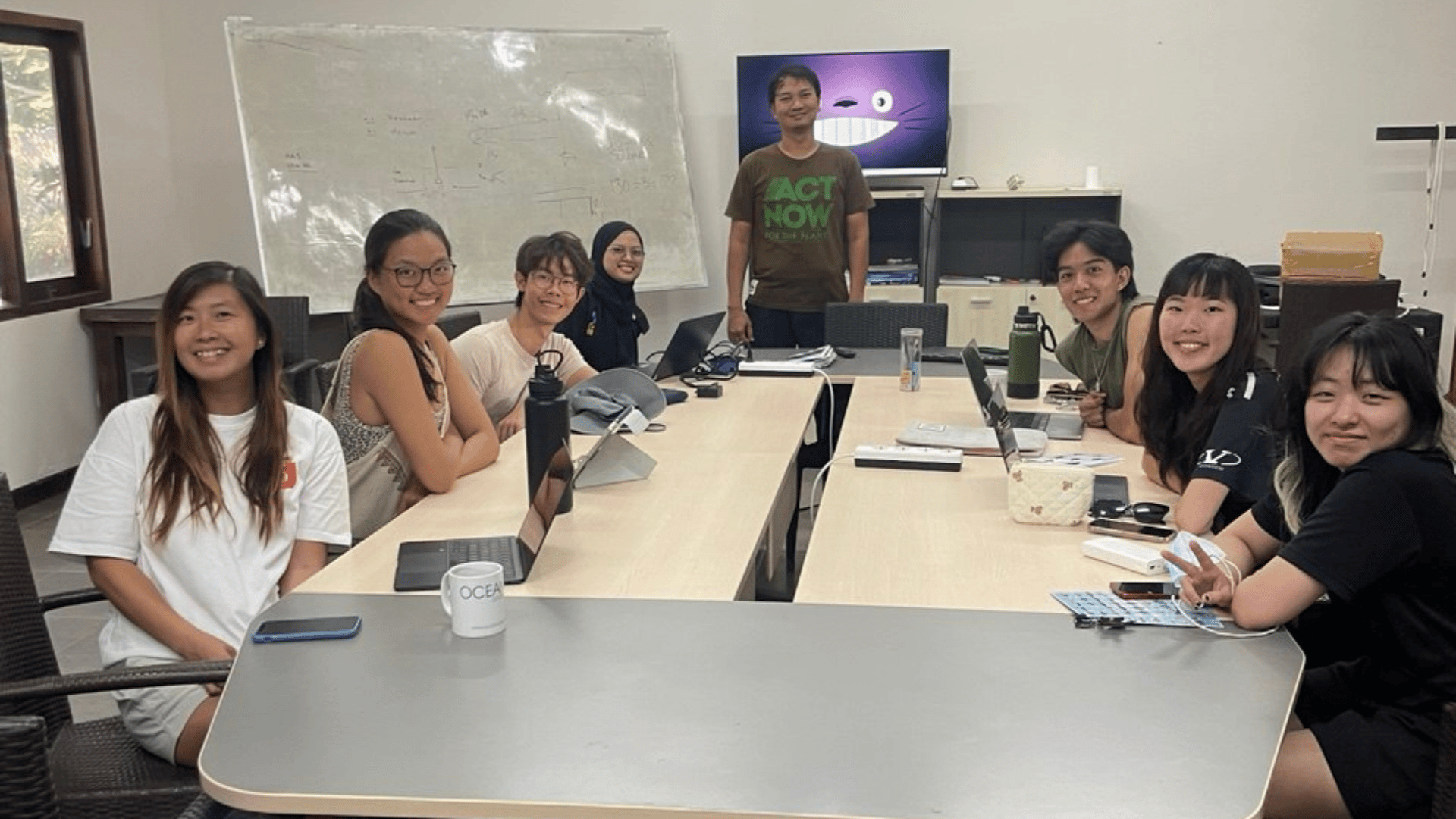 Shell-utions with UNRAM during a collaborative working session on turtle conservation. From left: Prof Sam, Ching-Hsuan, Ka Fye, Prof Wiwid, Prof Dika, Jason, Clare and Ebelle. (Missing from photo: Hwang Dowon) (Photo: Shell-utions)
Beyond pulling off the platform, their encounter with a passionate like-minded community was another great reward: Cakra from Marine Conservation ID, a freelance dive instructor who has spent years quietly trying to improve turtle data collection, largely on his own, simply because he believes it matters. Or Prof Wiwid and Prof Dika from UNRAM, professors whose passion for their local marine ecosystems is matched only by their depth of knowledge.
“Working with UNRAM and Marine Conservation ID made me feel very connected to the cause. As a business student, most of my work is corporate. But this felt like something truly meaningful that can make a real difference,” shared Ebelle.
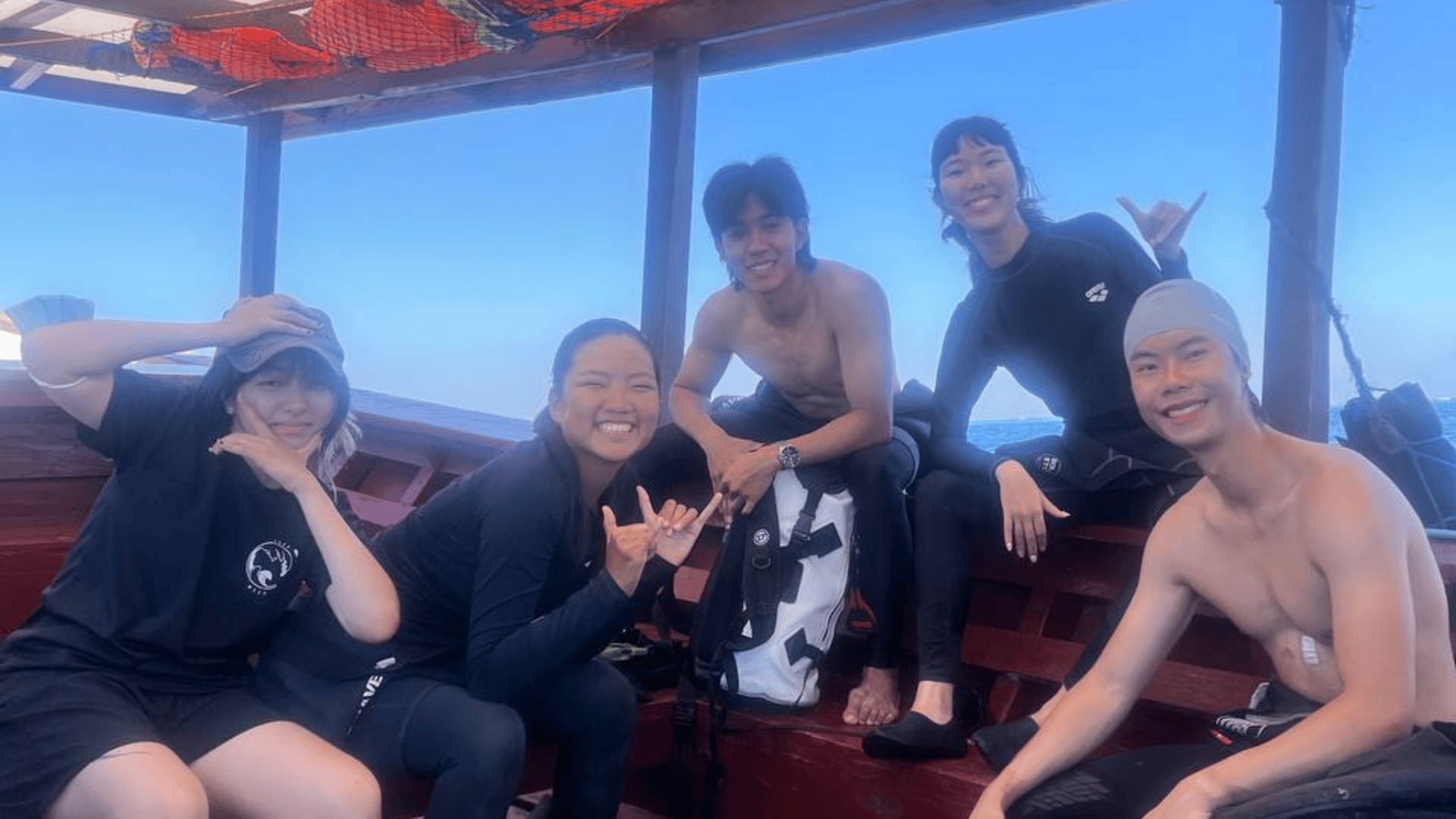 Shell-utions fresh off a dive session collecting underwater turtle footage. From left: Ebelle, Ching-Hsuan, Jason, Clare and Ka Fye. (Missing from photo: Hwang Dowon) (Photo: Shell-utions)
Empowering a Community from Within
Team Sabah Fish, comprising NUSC students – Amy Woon, Chia Zhen Kai, Dillon Poh, Gabriel Yong, Shannon Lam, Sze Arin and Tay Yu En, guided by NUSC Lecturer Dr Ng Keng Khoon, were called to the serene Pulau Larapan, a short boat ride from Semporna, Malaysia to empower a very tight-knit indigenous Bajau community there.
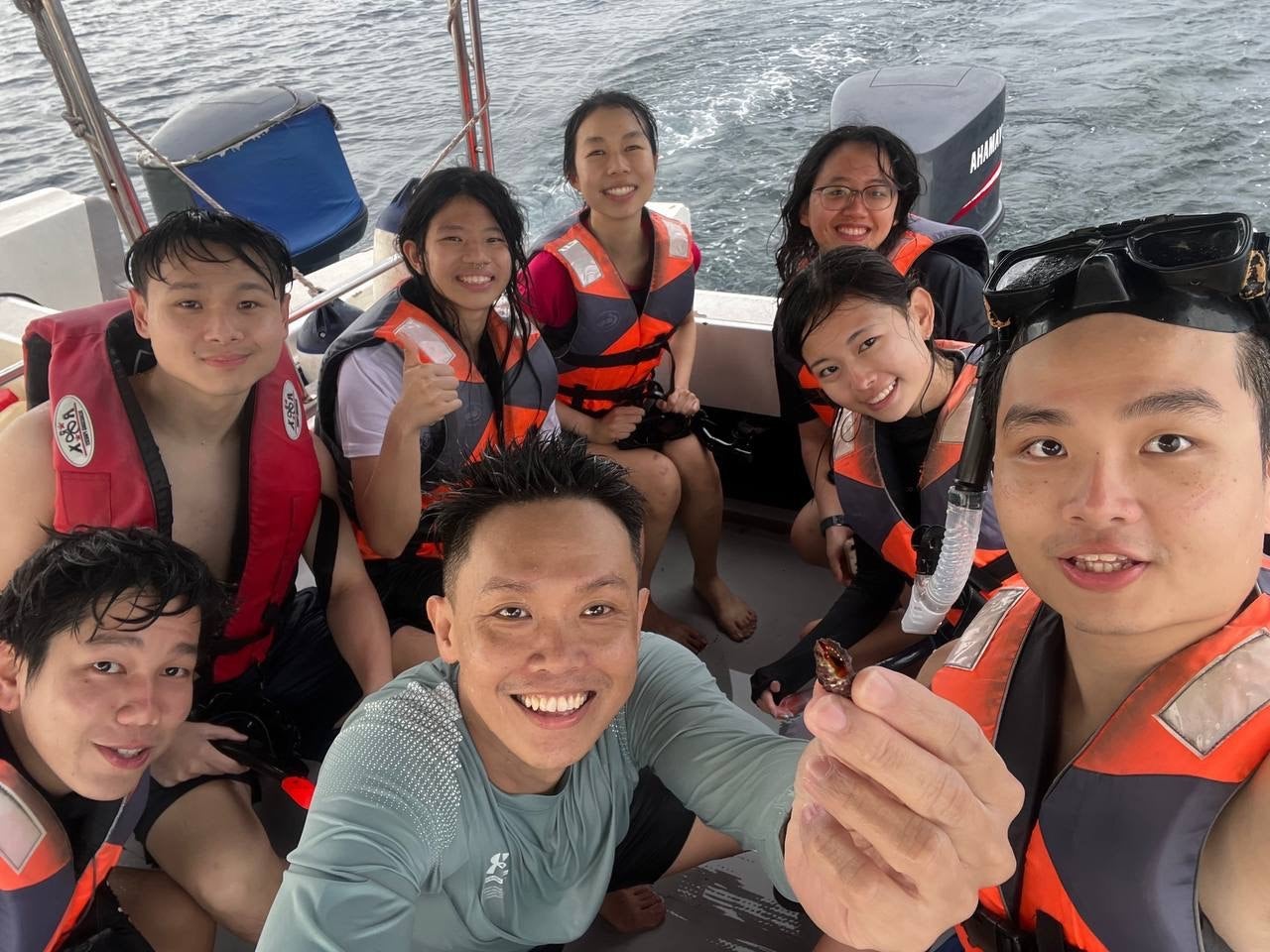 Team Sabah Fish out on the waters of Semporna with their local guides. (Clockwise from centre: Prof Ng, Gabriel Yong, Zhen Kai, Amy Woon, Shannon Lam, Yu En, Sze Arin and Dillon Poh) (Photo: Team Sabah Fish)
Although Semporna is world-renowned for its diving and marine tourism, Larapan has been largely untainted by tourism until recent times where two new resorts have appeared on parts of the island. Now, the community is at a crossroads: whether to adapt on their own terms or risk having the tourism industry shaped for them by outsiders.
When the team arrived, they found a community teeming with life – warm, welcoming and always eager to lend a hand. They spent hours on the island’s long jetty with the village children, playing local games, attempting handstands and chatting well past sundown. It was not long before they fell in love with the place and its people.
“It was quite magical. The children just walked up to us, followed us around and wanted to hold our hands. The community was so open and warm – it reminded us why this work matters,” shared Gabriel.
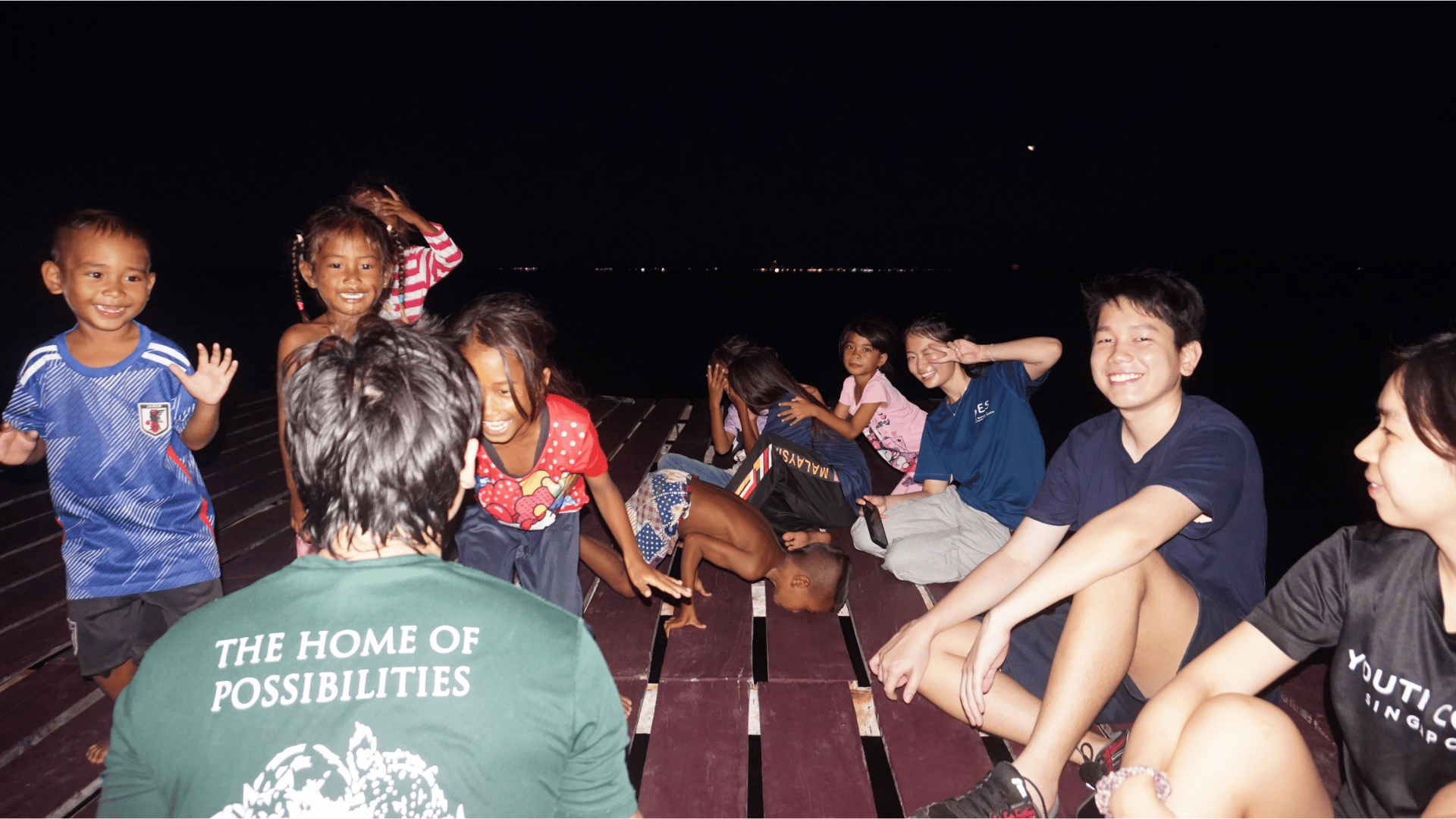 Laughter well past sundown as Team Sabah Fish hangs out with the children of Pulau Larapan. (Photo: Team Sabah Fish)
But beneath the warmth lies a serious reality. Indigenous Bajau communities have historically been excluded from and exploited by the marine tourism industry. Pollution, cultural erasure and environmental damage often follow in tourism’s wake. Team Sabah Fish’s mission was to help the Larapan Bajau take ownership of their island’s future before external forces took over.
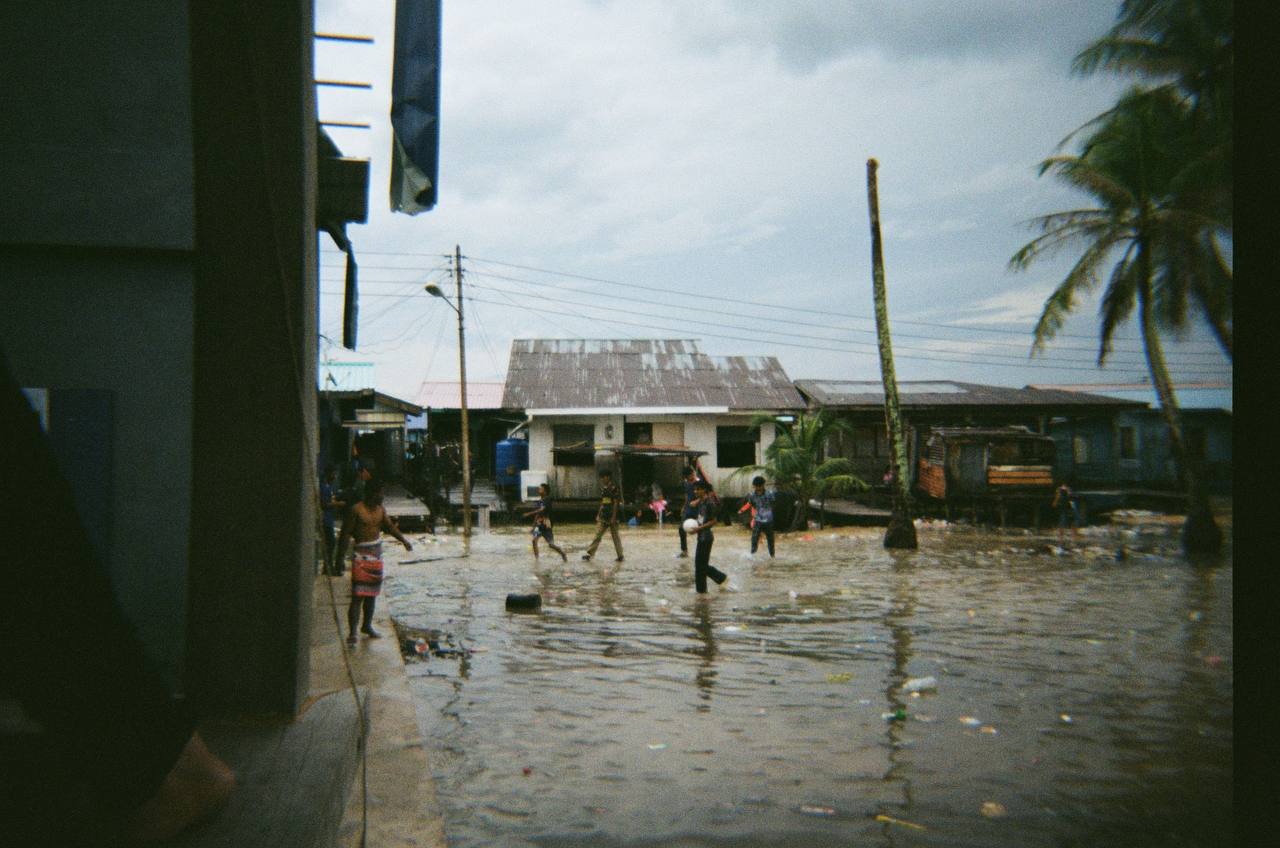 Locals engaged in a ball game in Pulau Larapan, where Team Sabah Fish found a community deeply rooted in the sea and one other. (Photo: Team Sabah Fish)
The team’s approach to Pulau Larapan was similarly grounded in the belief that lasting change must come from within. Their project, Project Suara Laut Semporna, centres on piloting a sustainable, community-led ecotourism model for the island. One that re-packages Larapan’s natural beauty and Bajau culture into an authentic experience for visitors, while ensuring the proceeds flow back to the community itself.
As such, the team made sure that their current initiatives are what the community themselves have asked to learn – capacity-building workshops on public speaking, photography, Microsoft Excel and presentation skills. They are also supporting the planning of a community-run dive centre, an idea proposed by the village chief himself. It would offer snorkelling tours and dive equipment rentals, with proceeds channelled back into community development on the island.
The team is careful about one thing above all else: that this remains the community’s project, not theirs.
“We do not want it to seem like we are the ones running things and the community is there to help. It is the other way around. We actually had to clarify that with the village chief on our last trip,” emphasised Gabriel.
For Team Sabah Fish, the biggest barrier was language. Working closely with a community was difficult when conversations were stilted and nuance got lost in translation. The team relied on a combination of human translators, Google Translate and carefully prepared Bahasa Melayu workshop materials. They did their best to bridge the gap, although an easy, flowing rapport sometimes remained out of reach.
The team stayed unfazed and determined to see their project brought to life by the community – which translated into establishing a local taskforce within the Larapan community to oversee and drive the ecotourism project forward. It means handing over resource packages so the community can run their own workshops long after the students have graduated. It also means passing the baton to future IEx batches, so the work continues to grow.
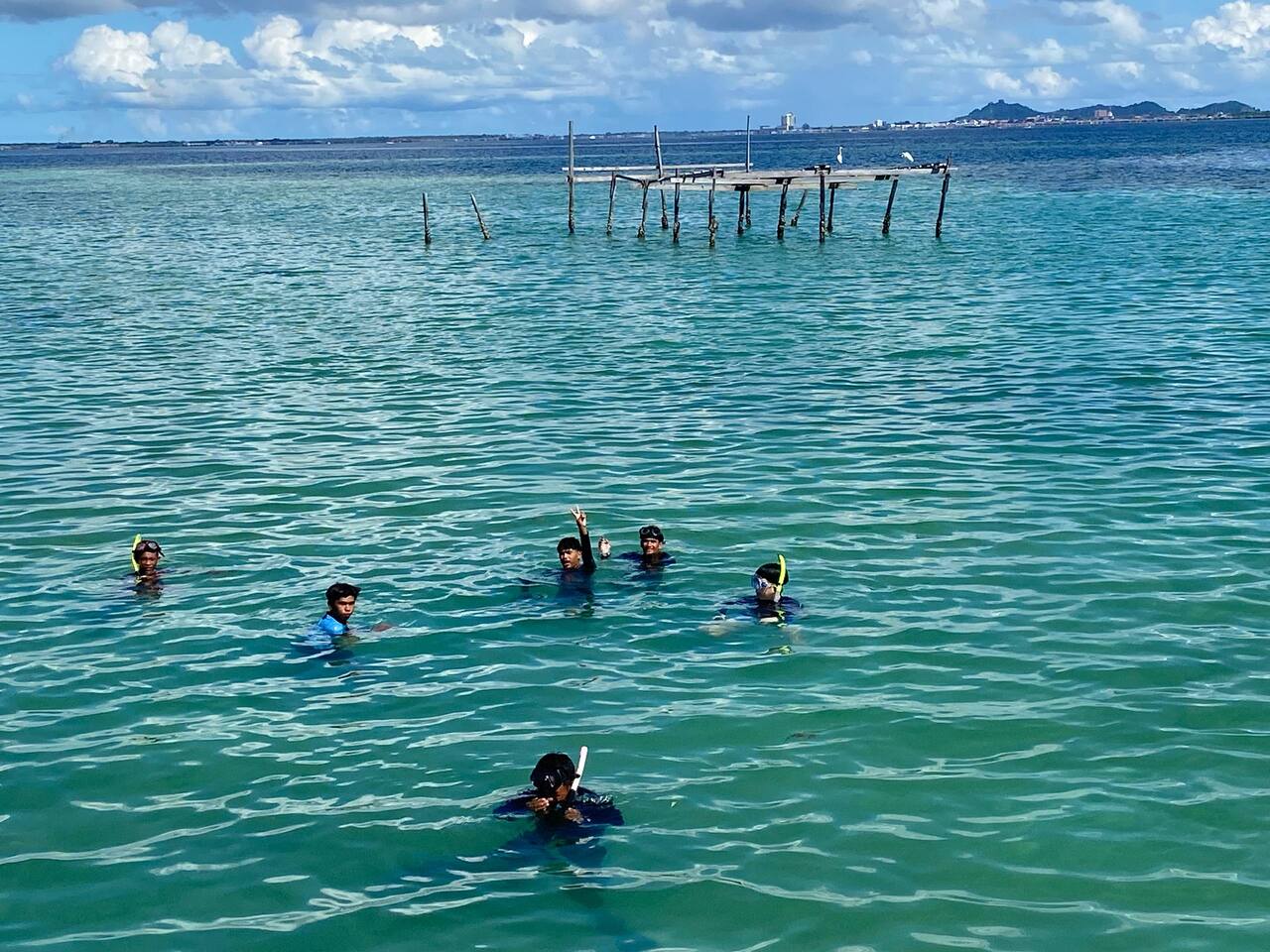 Diving into community-led ecotourism: Team Sabah Fish snorkels in the waters of Pulau Larapan alongside local Bajau guides. (Photos: Team Sabah Fish)
Through it all, what kept the team going was simply witnessing a community that is deeply, instinctively connected to the sea and understanding that protecting that connection is worth every mistranslation and logistical headache along the way. Sitting on the jetty at sundown with the local children who had never met them before and feeling entirely at home was a moment forever etched in their hearts and minds.
True Impact Beyond a Project
More than academic knowledge and technical skills, what both teams took home were life-changing experiences, skills to solve problems, the humility to listen and the heart to keep going. That is what NUSC’s IEx programme is exactly designed to do.