
By Marcus Chua
Residential Student Life Manager, NUS College
‘Inside the Industry’ brings NUS College students into workplaces to meet alumni and encounter different professional worlds firsthand. Through informal two-hour visits combining conversations about an alum’s career and personal journey, candid Q&As and workplace walkabouts, the series offers students a glimpse into both the work itself and the lives and choices behind it.
I spent my college years as a Philosophy, Politics and Economics major contemplating, and working towards, the well-lived life for myself. My friends at Rainbow Centre last week got me thinking instead: how might we become partners, as a community, in building the “Good Life” for our friends with disabilities in Singapore?
I love that I come from a liberal arts college tradition where friends from all walks of life, sometimes because of, and many times despite, their majors, have gone on to pursue a cornucopia of vocations. Through them, I have learnt to embrace and advocate for a flourishing society that accords dignity and wonder to every personal story. Interdisciplinary learning, to me, means more than acquiring knowledge across academic fields. It includes getting our feet wet in different parts of society, learning to see the world through the people who inhabit them, and building relationships along the way.
That thinking gave rise to Inside the Industry, a series I started for my residents at NUS College, where I serve as a Residential Student Life Manager. I reach out to fellow alumni working in different fields both to show moral support for their work and to give students a contextually richer dive into their worlds and journeys beyond the job description. Previously, we toured a preserved Chinese clan association house where an alumnus served as curator of its community museum. This time, we visited Rainbow Centre, a social service agency that empowers persons with disabilities to thrive in inclusive communities. In other words, Inside the Industry is meant to go beyond a career talk or learning journey, and certainly beyond something merely informational. In fact, I always encouraged students who think a particular industry has little relevance to them, to all the more come along for such programmes they may have too quickly deemed irrelevant. For the point is not always to facilitate you towards your predetermined goals, but to vicariously experience parts of society and the people within them that you otherwise might not have encountered.
Our afternoon at Rainbow Centre’s Margaret Drive campus began with a bubbly welcome from Crystal Yong, Senior Executive for Advocacy and Community Engagement. Crystal introduced us to the Centre’s work across the lives of persons with disabilities and their families. Students soon began finding connections with their own worlds. Precious Hong (Food Science and Technology + NUSC’ 27) who also studied nutrition, was naturally drawn to the hydroponic system she later encountered at the Day Activity Centre. It prompted her to ask about nutrition education and healthier-choice labels, and she reflected afterwards on how the visit allowed her to connect what she studied with the rather different worlds of education and social services. Instances as those demonstrated interdisciplinarity in action: Precious had entered somewhere unfamiliar without leaving what she already knew at the door.
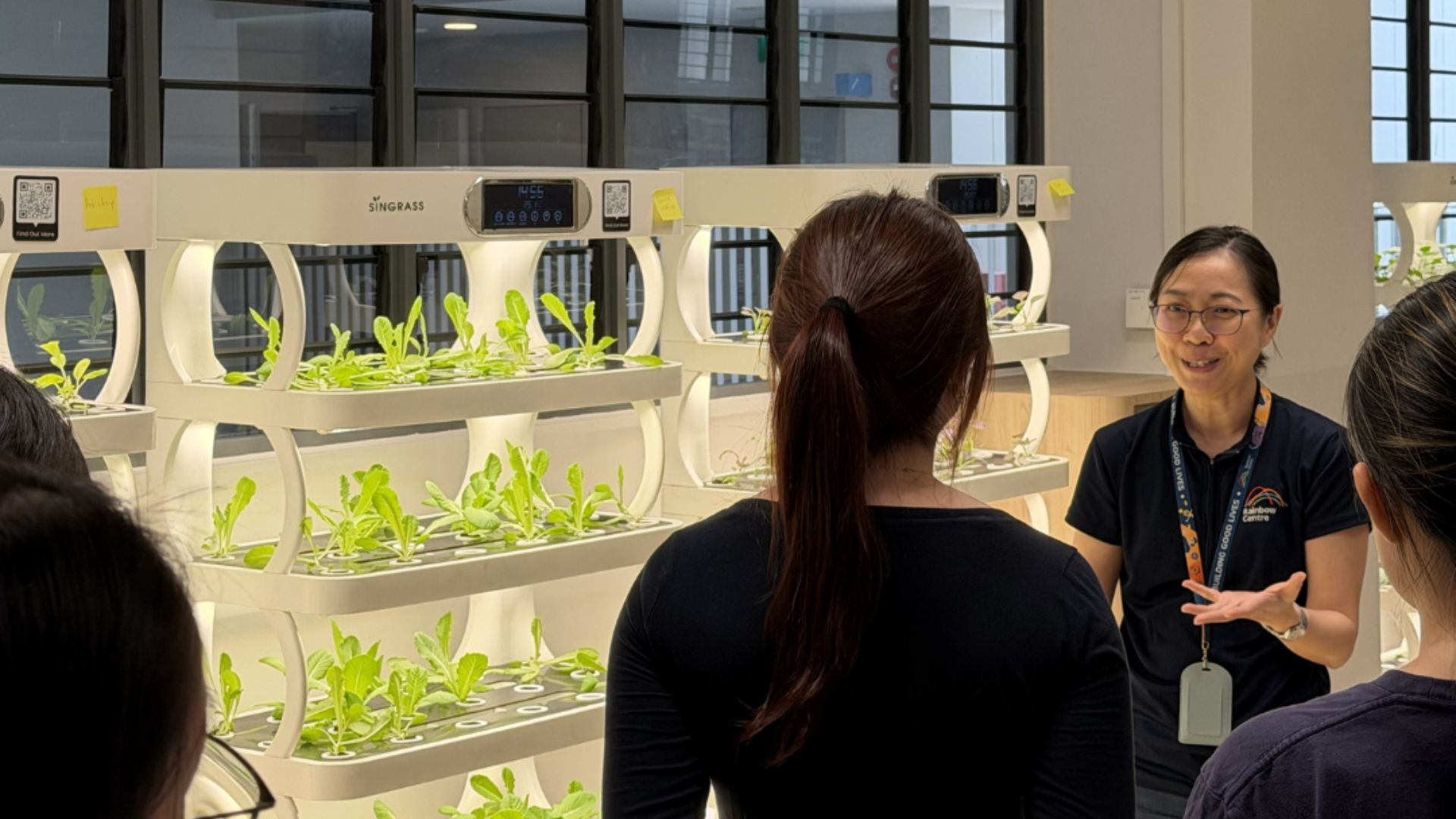 Ann Chi Lim, Head of Adult Empowerment Services, sharing about the modularity of the Day Activity Centre (DAC) alongside its hydroponic setup
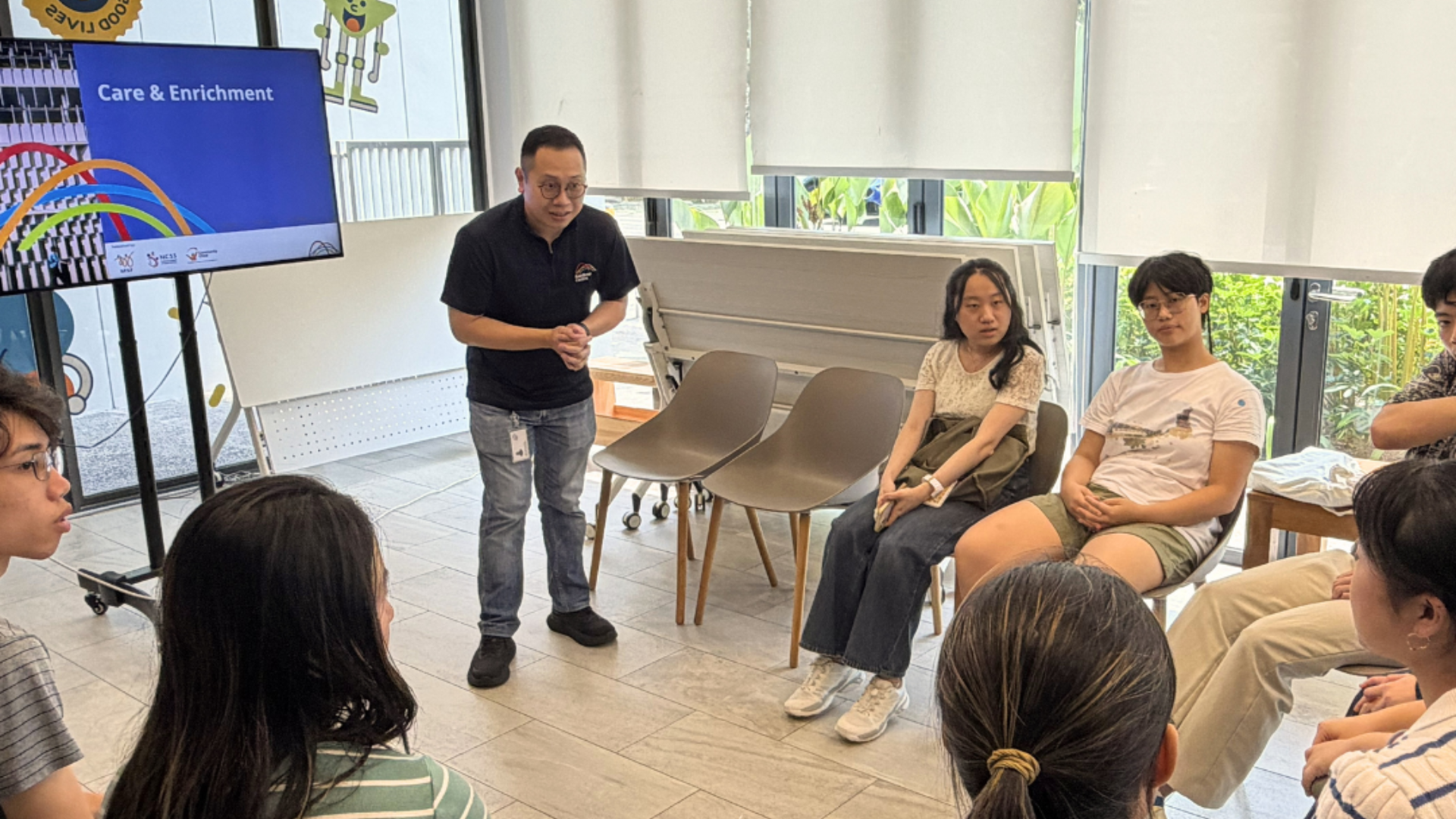 Sharing by Calvin Eng, Senior Manager for Care and Enrichment, on the Centre’s Good Life framework
Calvin Eng, Senior Manager for Care and Enrichment, introduced us to his work centred around the Centre’s Good Life framework. The aspirations of a Good Life were remarkably simple: being independent, being engaged, being included and heard, and being safe. We saw these aspirations take on everyday forms through the Out-of-School-Hours (OOSH) programme. Rather than replicating the literacy and numeracy goals of formal education, OOSH focused on functional skills that could stay with students through life: eating independently, washing up after themselves, sweeping, folding clothes and doing the laundry. Calvin also regaled us with their recently developed Good Life Boarding (GLB) programme, including first-of-their-kind Stay-In Residencies where students practised independent living away from their parents, complemented by Caregiver Coaching to help transfer that learning home. Throughout, I sensed among Calvin’s team a palpable joy and belief in building a better society through inclusion and empathy. Manae Higashibata (DDP Waseda & Political Science + NUSC’ 2030) reflected to me later on a distinction she had developed through the visit: where she had previously approached persons with disabilities with pity, the Centre’s environment showed her what approaching them instead with empathy and a genuine desire to understand could do. I found that distinction particularly apt during our subsequent tour of the Centre, where Crystal’s choice of stops drew our attention to the littlest nooks and crannies of personalisation and intentional design. Suffice to say, Rainbow Centre’s empathy manifested itself in the extraordinary specificity of care behind seemingly ordinary things.
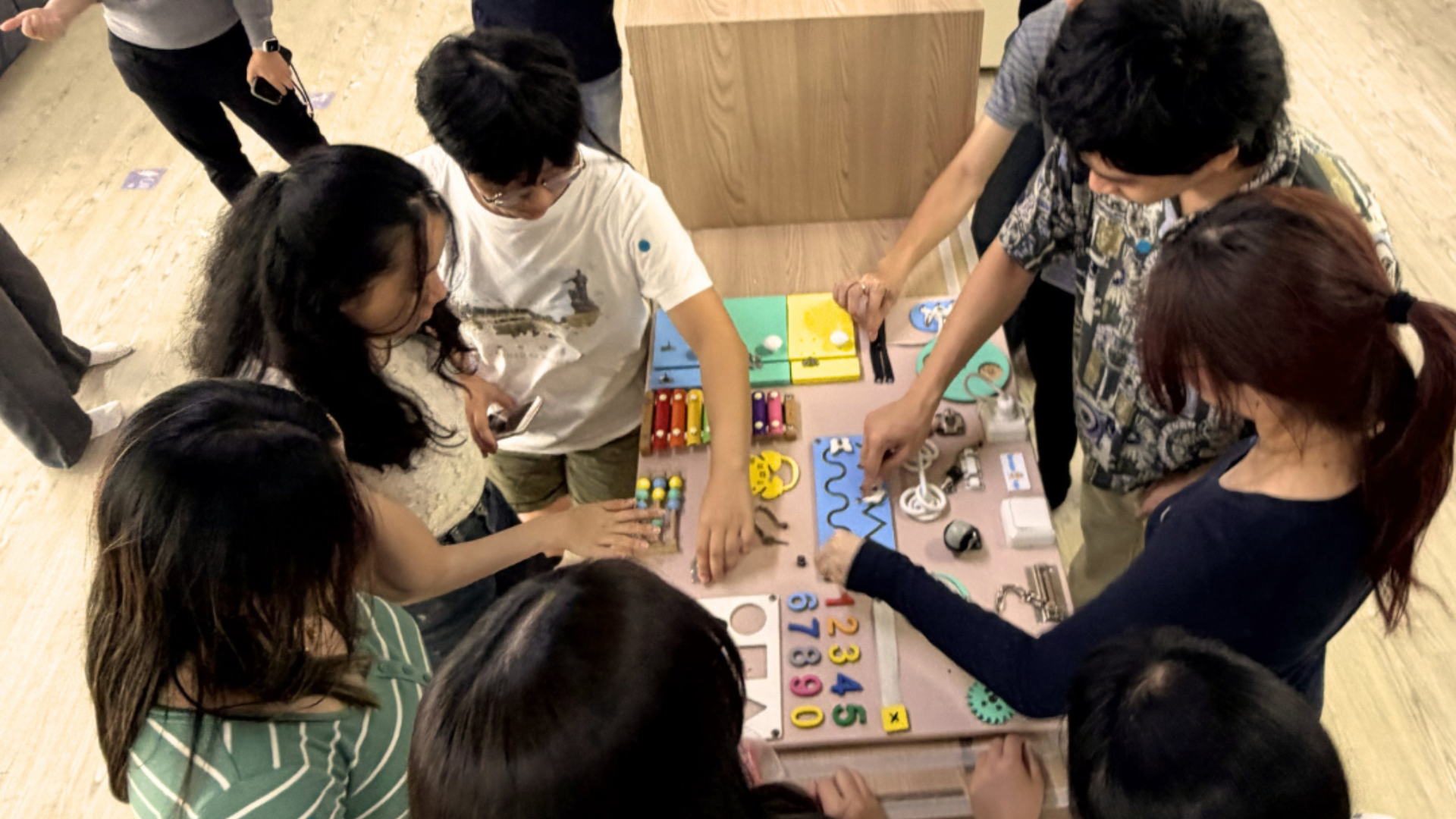 NUSC Students interacting with toys found in OOSH (Out Of School Hours), the Centre’s special student care centre
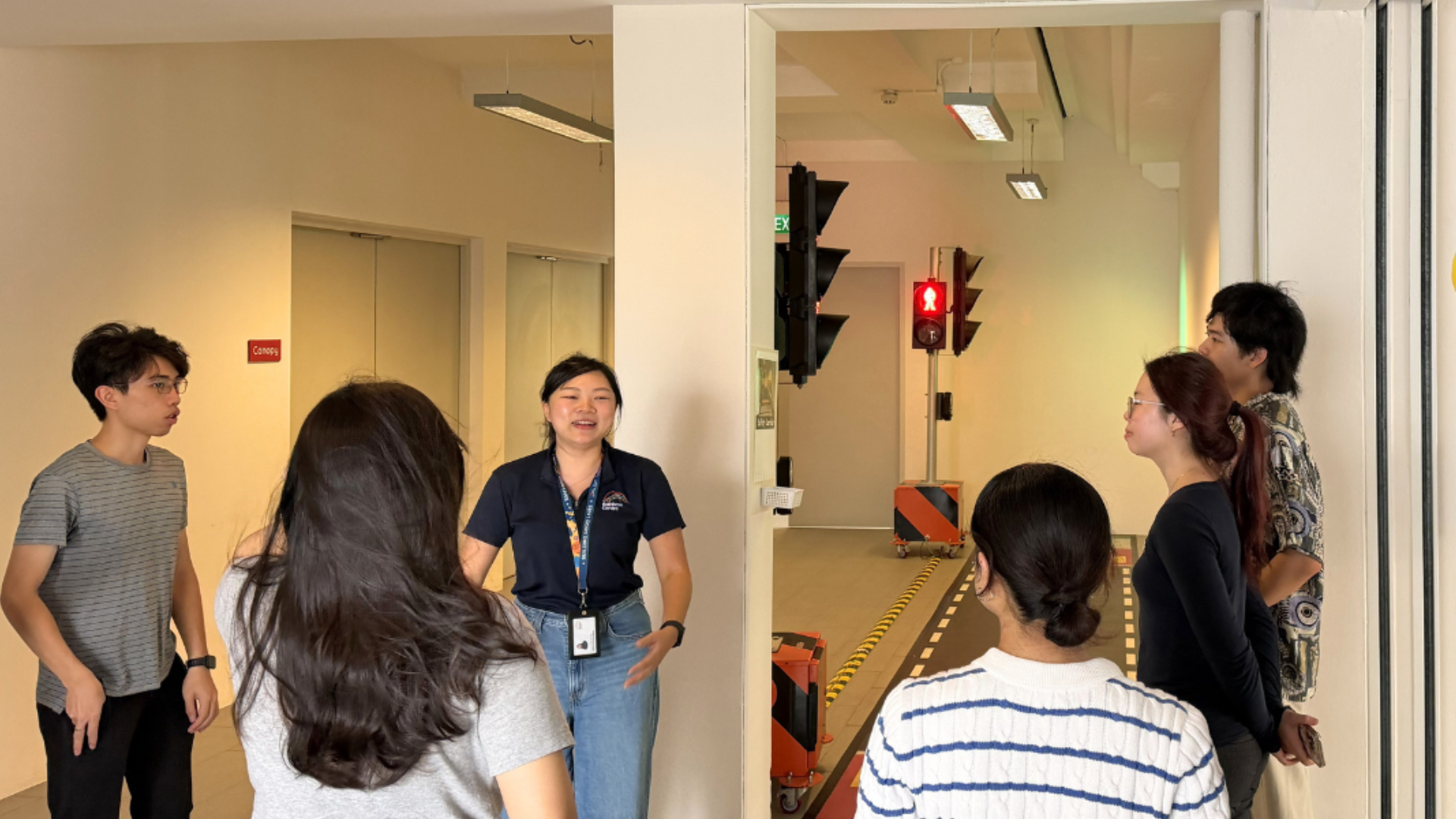 Crystal Yong, Senior Executive for Advocacy and Community Engagement, explains one of various collaborative installations to help the Centre’s students navigate public spaces
We also had quality time with Ann Chi Lim, Head of Adult Empowerment Services, who brought us through the Centre’s Adult Empowerment Services and Day Activity Centre (DAC). Across the tour, we saw how cooking noodles could require a carefully structured visual work system; how students could practise handling money and navigating public transport in purpose-built spaces; and how learning archery might mean marking where someone should stand, placing a sticker where their hand should grip the bow, and breaking what looked like a single motion into several accessible steps. From the modularity of the spaces to multipurpose rooms for quiet, domestic-skills practice and even a good karaoke session, Rainbow Centre presented a vision of independence cultivated through flourishing. What I eventually witnessed were cheerful helpers bolstering a community with extraordinarily thoughtful support; where the vision of independence was scarcely the graduation from support systems.
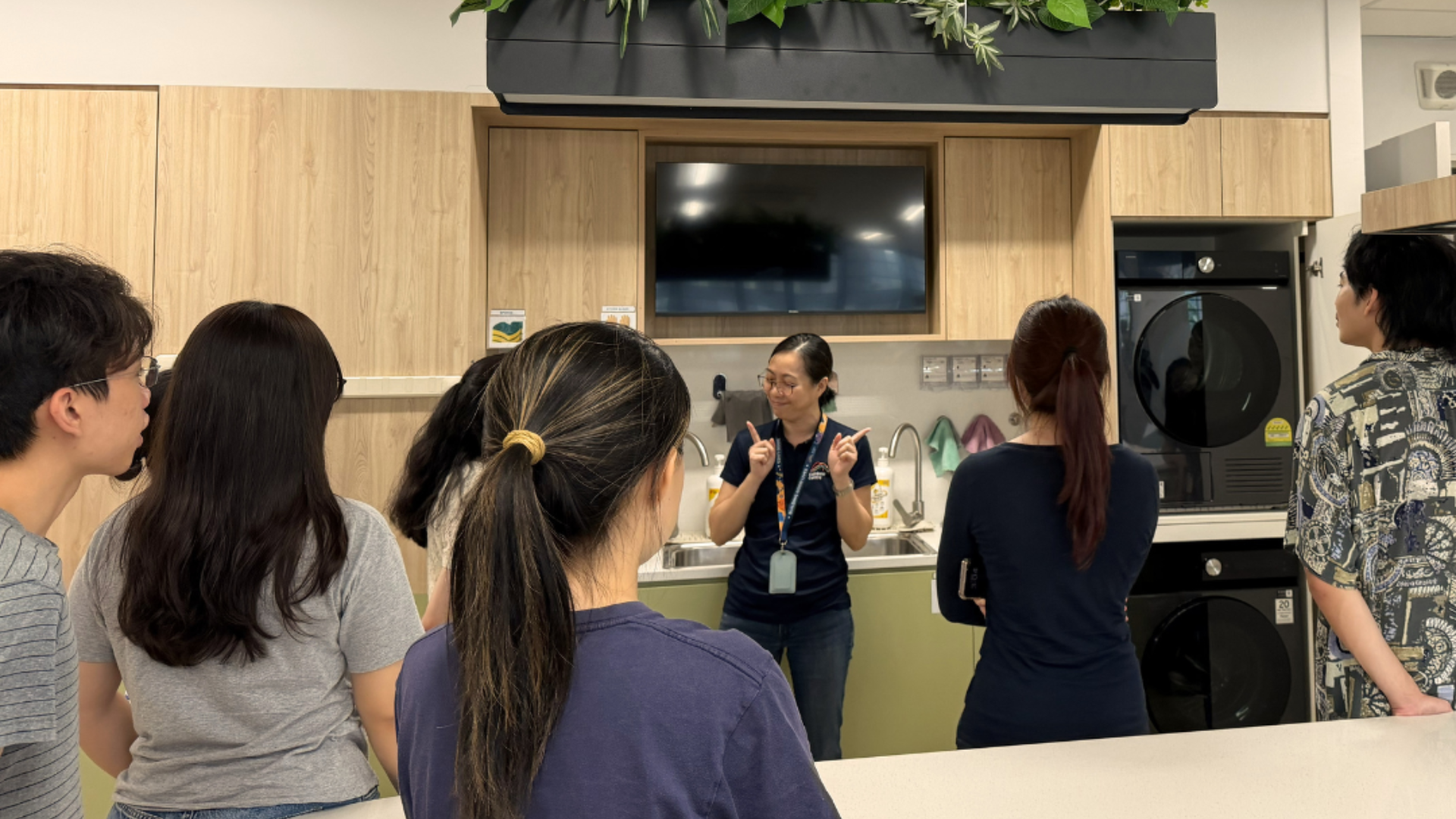 Ann Chi showing the household mockup for practising chores
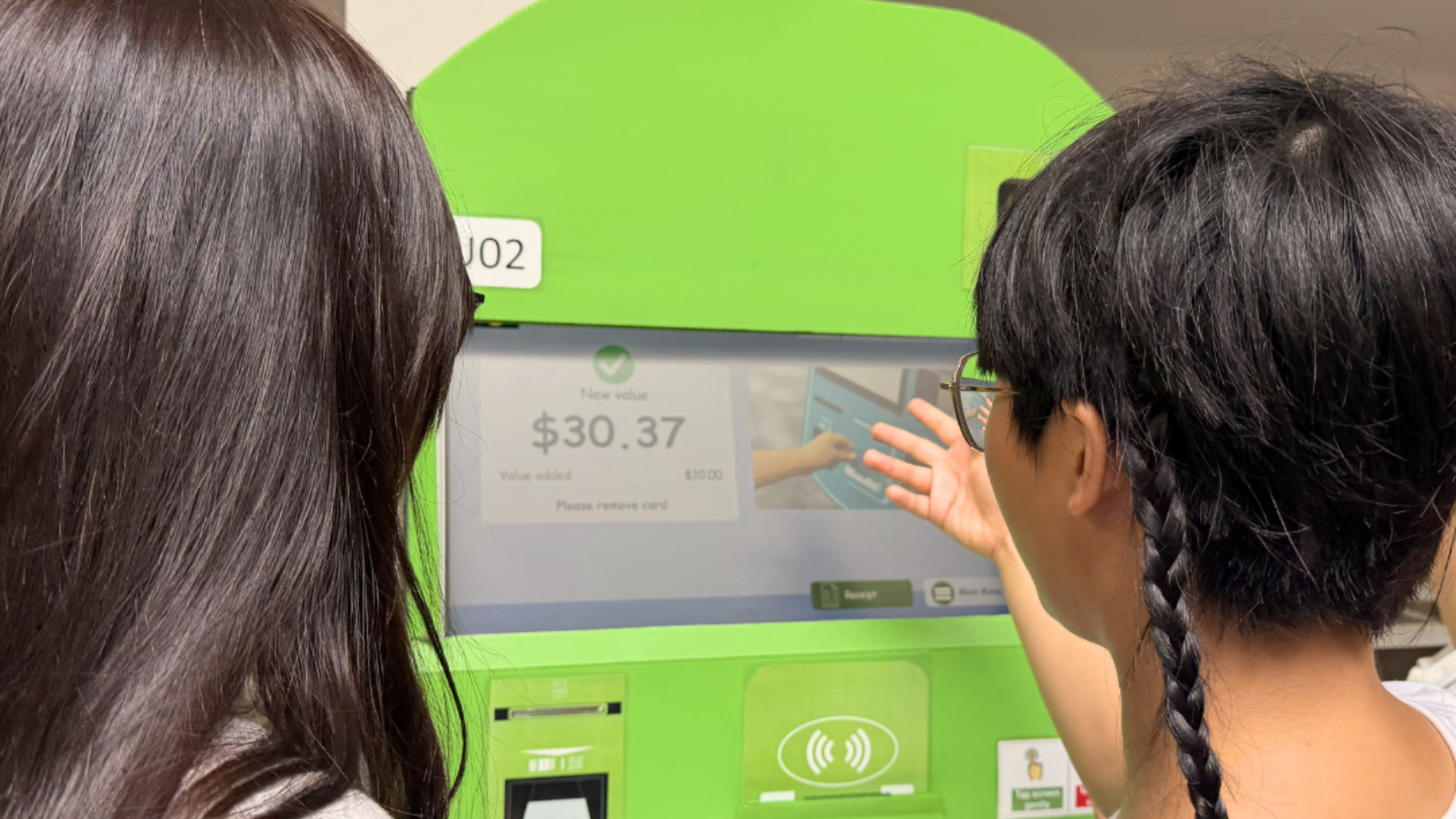 NUSC Students exploring the mock contactless card top up kiosk to help students familiarise themselves with the MRT system
To top it off, our introduction to Watch Out, World! (WOW!) was a special treat because its sharing came from Ang Ke Xin, Programme Associate for Care and Enrichment. Ke Xin was a fellow Yale-NUS alumna of mine, with a flair for her work but an even more compelling story marrying holistic education and vocation. Ke Xin began by showing us how WOW! activities were adapted around individual needs, with mentorship highly customised and the engagement of a wider community where programmes might remain sustainable beyond Rainbow Centre itself.
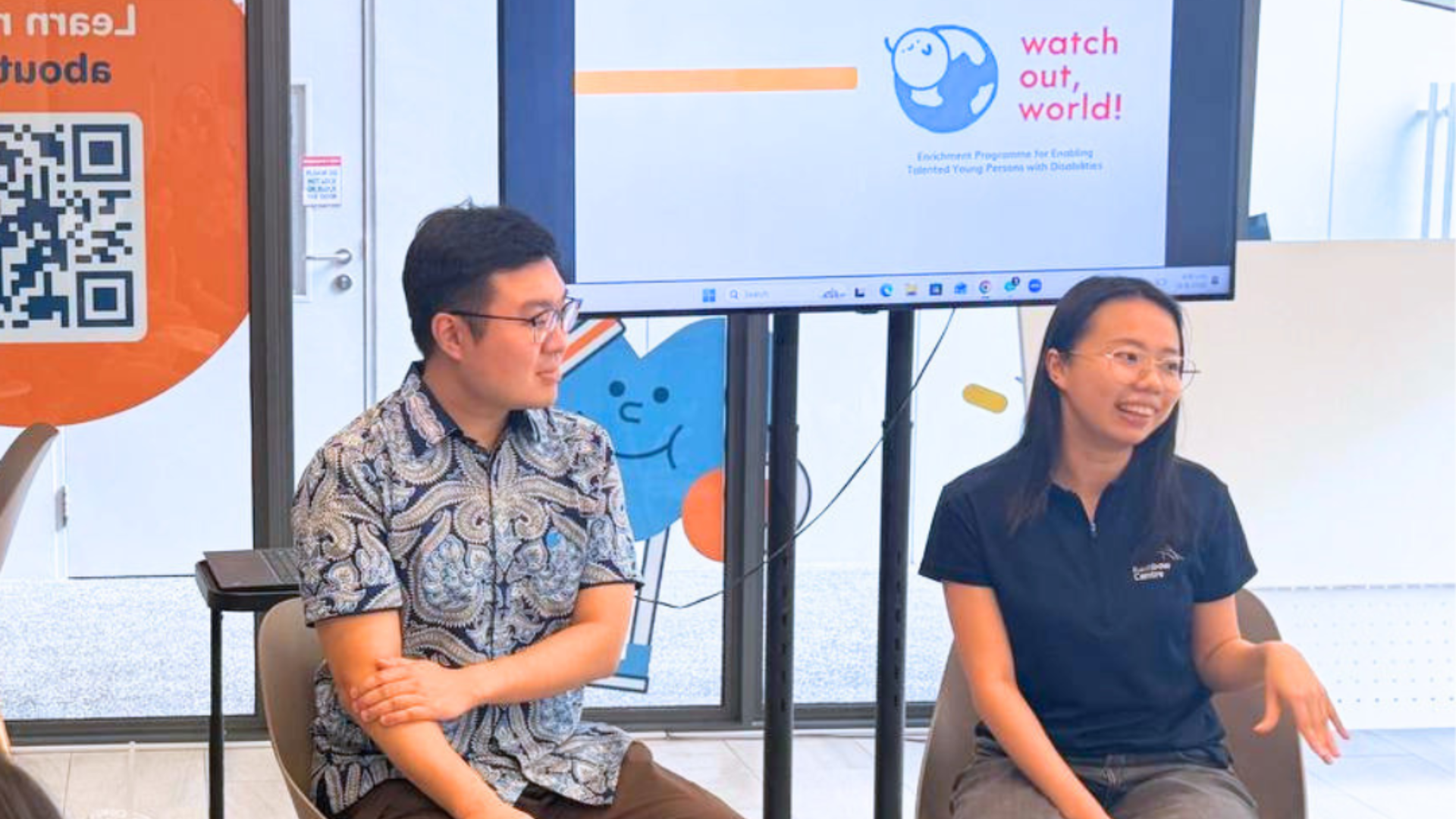 Marcus Chua, NUSC Residential Student Life Manager, in discussion with Ke Xin, Programme Associate for Care and Enrichment, on the journey from education and life experiences to vocation
I later led an open conversation between Ke Xin and our students about her own journey from Yale-NUS College and a liberal arts education into this work. We talked about the choices she had made beyond the classroom, the people she chose to spend time with, and how making time for reflection and curiosity had shaped the directions she eventually took. This kind of storytelling through the lens of a holistic education was precisely what I hoped Inside the Industry could offer my NUS College students. The workplace visit was not about selling them a profession, but authentically narrating one person’s journey: how unexpectedly an education might unfold, and how making meaning of it often involves grappling with normative ideas of success and deciding which of them should matter to us.
Benaiah Leong (Sociology + NUSC ’30) reflected afterwards on the remarkable amount of detail that had gone into making Rainbow Centre’s environments accessible and welcoming, all while having programmes customised around individual students. He recalled how his impression of Calvin, Crystal, Ke Xin and Ann Chi quickly evolved from caregivers to teachers, mentors, and advocates who help students discover hobbies, interests and things they might genuinely enjoy. His reflection captured the “Good Life” as one where flourishing entailed more than simply being cared for. I could not agree more.
And so I was glad our small group itself crossed majors. We saw Computer Science, PPE, Psychology, Sociology, Food Science and more. Regardless, the point was never that everyone should leave wanting to work in this sector, but that they should leave knowing a little more about a part of Singapore, and about people and work, they might otherwise have passed by. We need more experiences like this, and I am glad there are more to come. Our group conversation eventually evolved into one about college education itself. Calvin put it well: such an education should develop the head — what we know and how we think, but also cultivate the heart — enlarging whom we understand and care about, and finally find its expression through the hands, as we enter unfamiliar spaces and do something with what we learn.
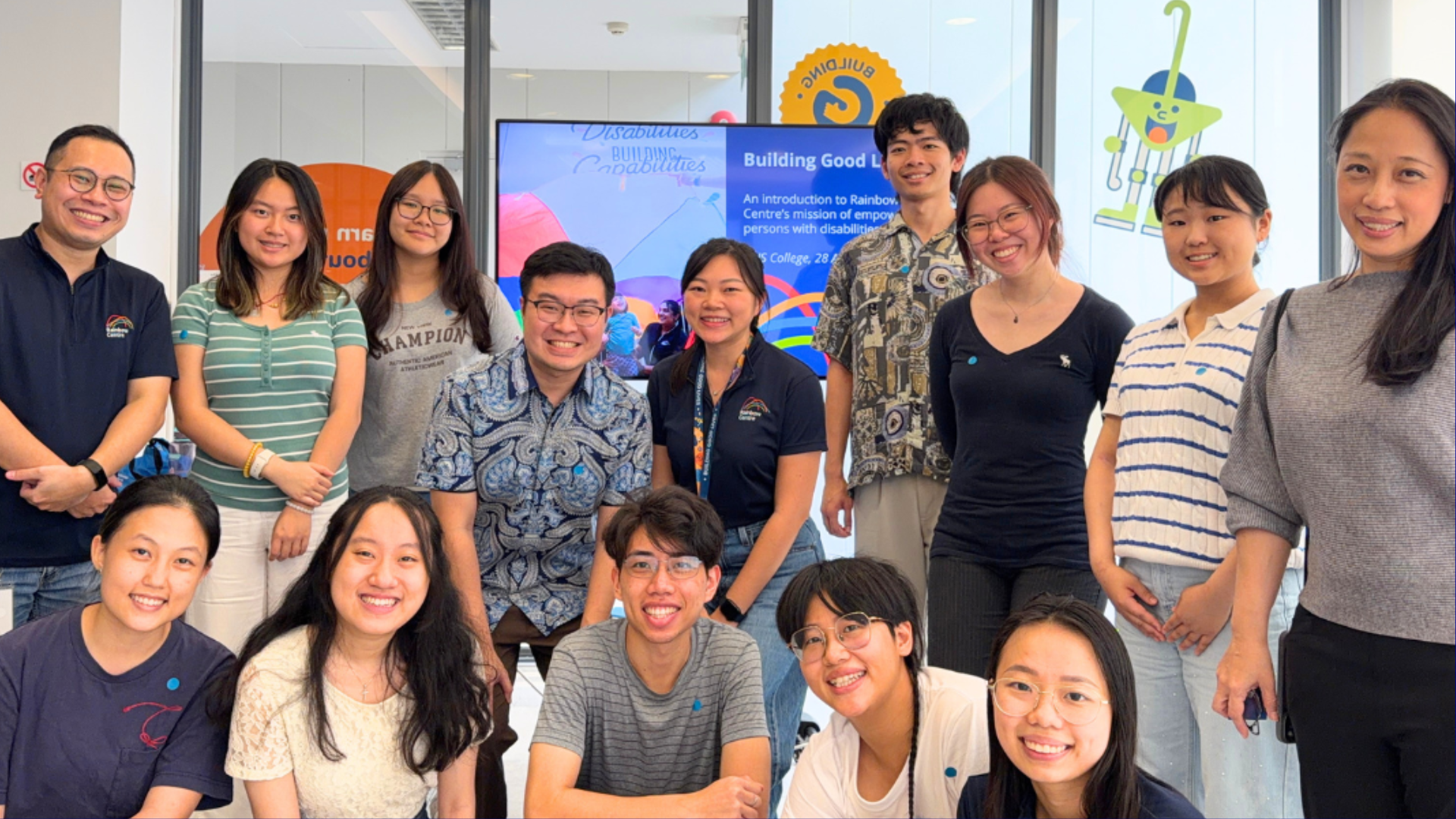 Host team from Rainbow Centre and NUS College visitors wrapping up a fun yet profound centre visit
At the end of our visit, an Old Chang Kee curry puff in hand courtesy of Calvin’s team, I asked our hosts what they would consider a good return on the two hours they had spent with us. Their answer fittingly pointed beyond the visit itself: come back. Volunteer. Spend time at the Centre. Get to know the community and contribute to it.
That was the most fitting answer to the initial question I had carried into Rainbow Centre about building the Good Life together. Students often ponder where their majors might take them. As for me, I hope we keep creating opportunities for them to discover that, by bringing their heads, hearts, and hands along with their majors, they might find themselves going places their younger selves could scarcely have fathomed, and one day be so glad they did.