By Marcus Chua
Residential Student Life Manager, NUS College
Marcus Chua reflects on Community Conversations, the programme he designs and runs for first-year students at NUS College, and what it might mean for the culture they build together.
Twenty or thirty minutes before Community Conversations began, I was already in the Saga Dining Hall, busy arranging coloured sheets of paper across the tables while ensuring that no two groups had been placed so close together such that they would eventually have to compete to be heard. In designing the programme, I found myself attending even to the ambient music; the choice tended to oscillate between Studio Ghibli and Singapore Airlines lounge music, which made for an unusual competition. However, the manner in which a room was prepared will already be part of the facilitation. Before anyone had spoken, the setting could already tell people something about the pace, mood and kind of attention being asked of them. I was aware that students might be rushing in from class still flustered, still thinking about an unfinished assignment, or simply carrying into the room whatever the day had already given them.
Students began arriving about fifteen minutes before the starting time, some in friendship groups and others alone. Instructions on the projected slide told them where they might sit: in groups of no more than six, gathered around clusters of coloured paper spaced across the hall and ideally with someone they had not met before. Some read the instructions carefully and complied. Some seemed not to notice them at all. Some understood perfectly well what was being asked of them, but nevertheless attempted to preserve the familiar geography of their friendship group. I simply watched these little negotiations unfold in real time.
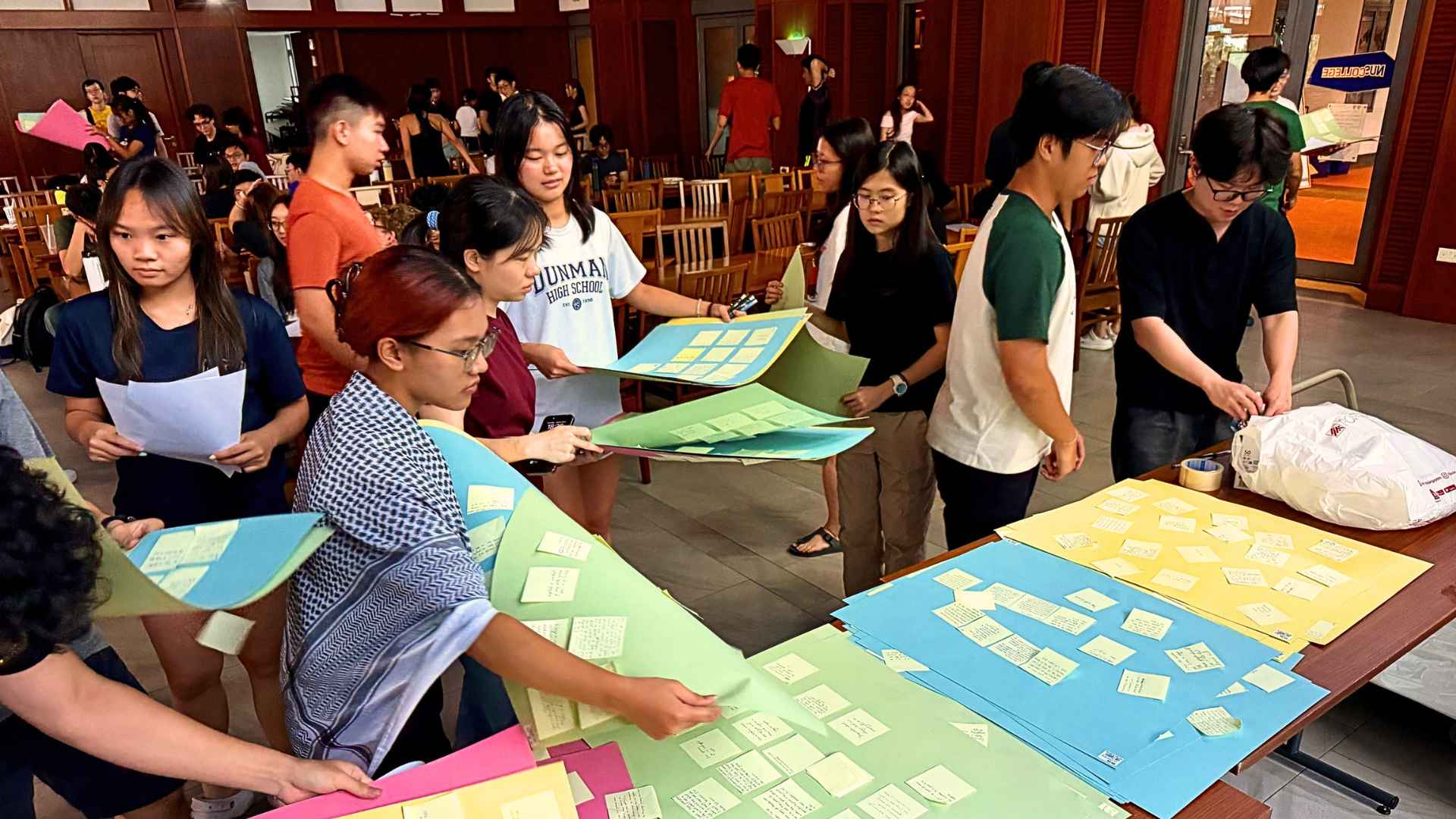 Group leaders retrieve canvases that already contain past participants’ responses to each colour-based prompt, allowing every subsequent group to indirectly interact across the cohort.
Community Conversations sits within the first-year experience at NUS College, following the Interpersonal Engagement programming that students encounter upon entering the College. Unlike a typical orientation programme, it arrives deliberately later – around weeks four and five of the first semester, when first-years have attended their first tutorials, met their neighbours and accumulated enough challenging, confusing or simply unfamiliar experiences for university life to have begun acquiring some texture. Approximately 400 first-years of the Class of 2030 took part across multiple sessions. By this time, the intensity of orientation had already faded and the first small routines of university had begun to establish themselves. Students now had enough context to reflect on what this place might actually mean to them, while beginning to navigate the differences that emerged from the many ways they had come to understand the College.
This year’s sessions revolved around four questions that seemed straightforward on a presentation slide: What am I grateful for? What am I prioritising? What am I carrying? What conversations do I want more of? The programme itself makes no promise that these questions will produce agreement, much less revelation. Instead, it invites students to approach one another with honesty, curiosity and care. Importantly, they are encouraged to practise making space for perspectives and experiences that may differ considerably from their own.
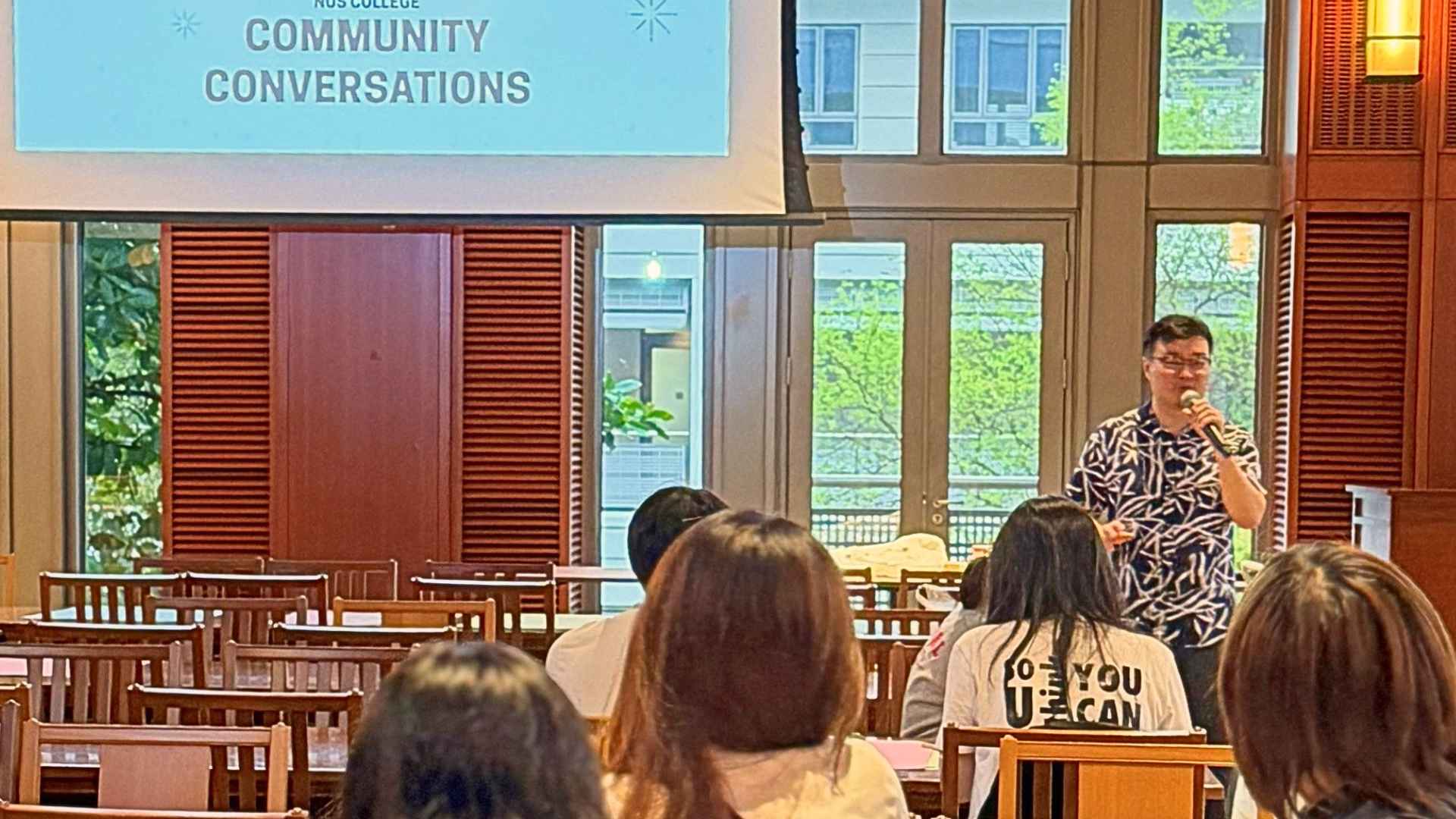 One of six Community Conversations sessions held for the Class of 2030 in their first semester at NUS College, with each session averaging over 60 participants.
There was, however, more choreography beneath the questions’ apparent simplicity. Students found themselves sitting before a coloured gallery sheet already populated by anonymous post-its from earlier cohorts of Community Conversations. While the first instinct was to begin reading them, I asked them to resist because I see value in first discovering what one would have written unaided when the prompt appears. As each prompt came up, the rhythm of the programme alternated between looking inward and looking outward. First, a period of silent individual writing, in which even those who finished early were asked to hold the silence for others. Thereafter, the chatter returned as students dispersed across the hall with their unnamed post-its in hand, planting their responses on another group’s gallery. When they returned to their tables, what awaited them was a sheet populated by the thoughts of others. This became the starting point for meaningful conversation as they took turns drawing out the reflections, questions and points of curiosity that mattered to them.
Importantly, the sheets revealed a messiness far greater than the machinery devised to collect them.
Under the first theme of gratitude were mentions of families and friends. These were the usual suspects, until they appeared alongside food, professors, lifts and water coolers that finally worked, sunshine (or rain), one’s health, one’s dog. Responses included ‘spontaneous invitations to supper’ and ‘people saving seats at lectures’, or even the simple fact that a suitemate leaves their door open. Local students found themselves reconsidering the otherwise unremarkable privilege of going home for the weekend after reading about international classmates being grateful simply for a phone call across time zones. Bryan Yap Zhi En (Physics + NUSC ‘30) reflected that the exercise had made him more aware of his friendships and surroundings, rather than treating them as part of the mere scenery of university life. It became clear that while gratitude may be a shared experience, what gives it meaning remains particular to the individual.
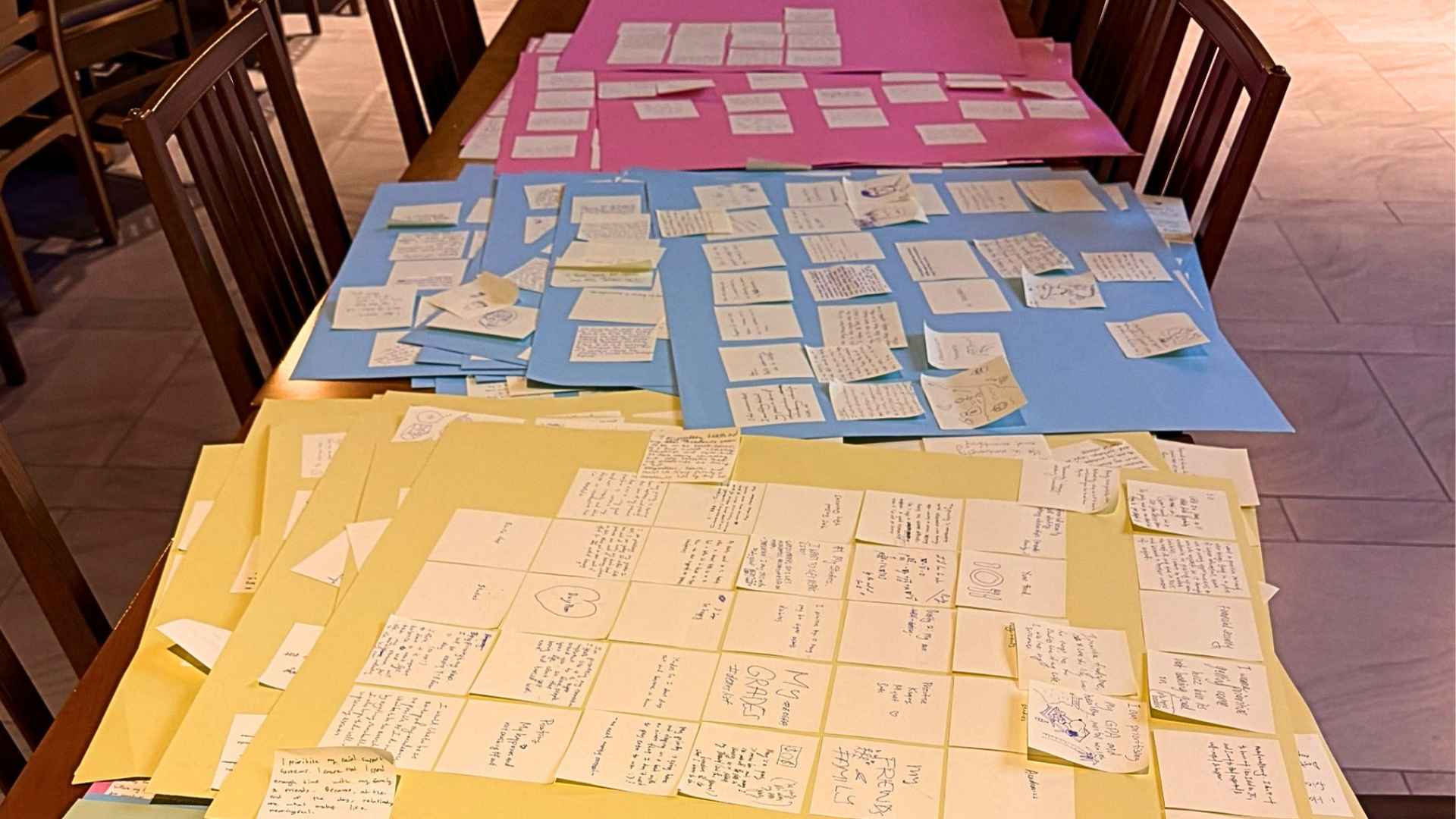 At the end of the sessions, galleries like these preserve hundreds of responses: earnest, humorous, brief and from across the first-year cohort.
The second theme, Priorities, complicated the picture. Academics became a recurring point of focus, as one would expect in a college, but so did sleep, health, relationships, faith, financial security, happiness, family, fitness and, in one pleasingly contemporary formulation, “sidequesting”. What interested me is less which terms were brought up most often, but rather, the unique histories concealed behind identical words. Two students who wrote ‘financial security’ or ‘family’ may have arrived at them through entirely different experiences. After all, the same priority can be interpreted and stewarded differently. Goh Jun Keat (Data Science and Economics + NUSC ‘30) reflected on the importance of having ‘regular and meaningful reflections’ to know ‘my priorities, values and things that I care about’. Another student articulated a related tension particularly well: we may appear to judge everybody against the same scale of GPA, commitments and résumés when the people being compared are not, in any meaningful sense, actually running towards the same thing.
What am I carrying? was the third question. This had always struck me as the most precarious question, because it risked suggesting that introspection must culminate in confession. Everyone moves through different seasons, and for some students, life is, quite simply, going rather well. There is no tragedy waiting to be excavated, nor should there have been. I expected some students to evade the seriousness altogether, as they did. People were “carrying” bags, Foodpanda orders and, in one case, “the weight of my Overwatch team”. Yet I did not simply discard these mischievous or jocose responses as noise. I recognised that humour, boredom, resistance and avoidance can be just as revealing when a community is suddenly asked to become earnest on command.
Beneath that levity, our first-year students were also carrying the weight of academic comparison, uncertainty about their majors and careers, financial burdens, family expectations, homesickness, anxiety about speaking English fluently and worries about the future and about falling behind (whatever falling behind meant to each of them). Several students reflected afterwards that seeing these things laid out did not eliminate their own anxieties so much as dislodge the peculiar conviction that everybody else had somehow escaped those anxieties. Someone described being reassured that apparently well-put-together peers were carrying pretty much the same things they did. Elsewhere, students were already thinking about the seemingly crippling financial responsibility they might one day bear for their families. For Peng Zuer (Quantitative Finance + NUSC ‘30), the lesson was that “people have different struggles and worries” and that “we should be more sensitive… we never know what people are carrying.”
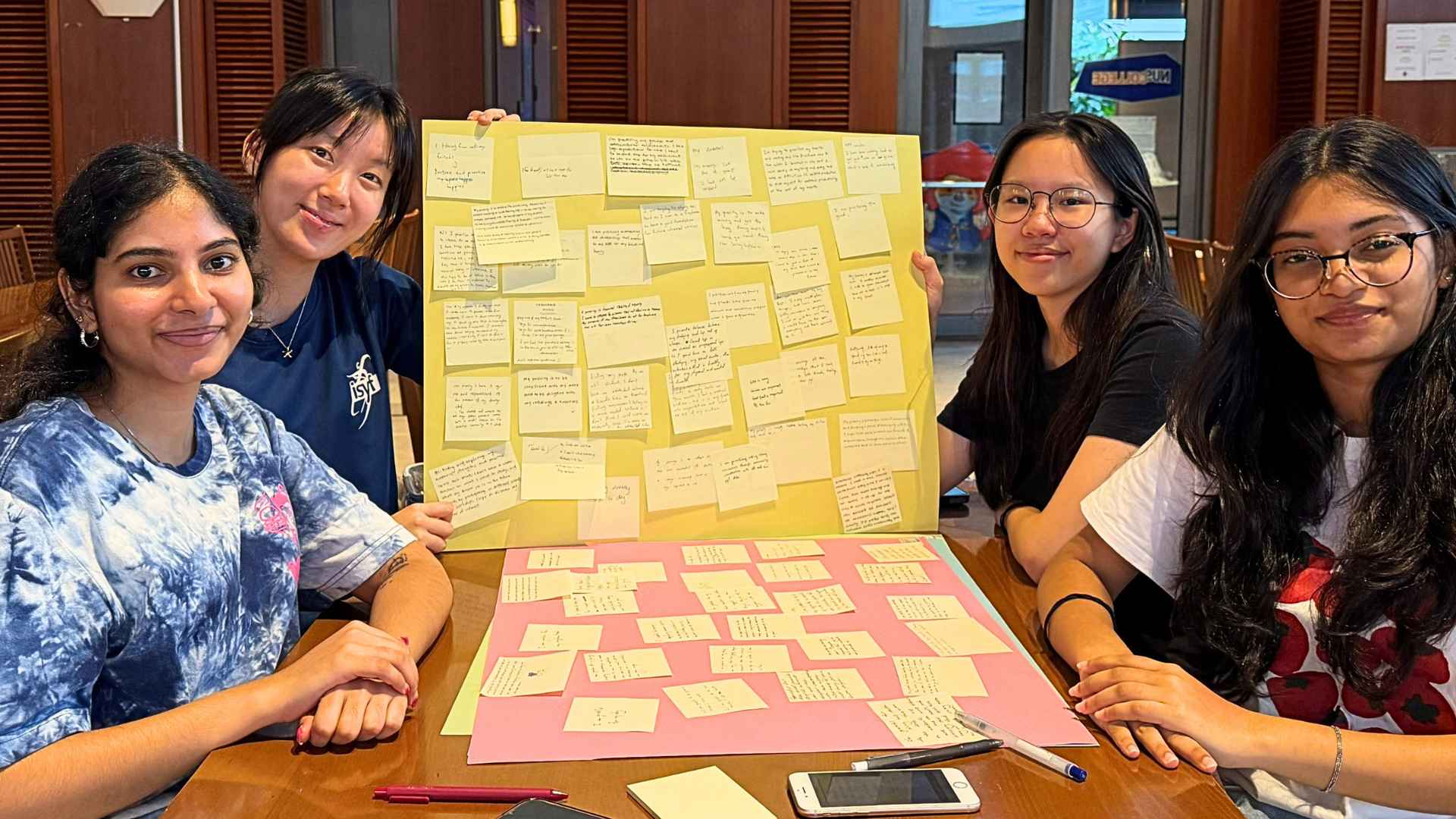 First-year students gather around a response-filled conversation gallery, using anonymous reflections from across the cohort as starting points for discussion.
As expected, not everybody welcomed the exercise. It would be dishonest to turn the thousands of responses across four rounds and six sessions into a choir that espoused the virtues of Community Conversations. One student found the third question invasive and declined to engage with it, expressing the need to protect their private interior life. Another appreciated the possibility of honest discussion, but felt that programmes of this sort could only do so much to make conversations among strangers feel truly authentic within a short span of time. A handful were ‘hangry’ (hungry and angry, all at the same time) and raring to leave, preoccupied with assignments, unconvinced that conversations of this sort required two hours of their time, or became irritated when cliques stuck together and fooled around rather than taking the spirit of mixing and discussion seriously.
I found such responses as useful as the affirming ones. For instance, an anonymous respondent questioned who gets to determine what counts as a deep or worthwhile question. Whereas Lim Zhi Yu (Business + NUSC ‘30) rathered “more time outside formalised events like these to engage and wrestle with the troubles and gratitudes of life”. Either way, such responses do not primarily serve as feedback to be woven into the next iteration of Community Conversations. Rather, they raised a difficult, but equally exciting question of how a college organises a culture of good conversations. More importantly, what kind of culture nurtures a diverse range of conversations to begin with?
This is the fourth evolution of Community Conversations since 2023, and I use the word ‘evolution’ deliberately because each annual iteration has been intentionally experimental by responding directly to the insights gleaned from the one before. What this iterative process has reinforced for me is that culture is built collectively, through repeated experiences, proactive friendships, shared expectations and the ways people gradually learn to be honest with one another. No single programme can culturalise a college, but Community Conversations has played an important role by giving first-years an early reminder to socialise with people beyond their usual circles, listen to others attentively, express uncertainty and encounter perspectives different from their own. Sun Yuxuan (Law + NUSC ‘30) was quick to notice that her friends and fellow NUSC students “have diverse perspectives, but we also have many similarities” – a fairly simple observation, but a clear articulation of what the programme is attempting to make visible. It comes with the hope that some of those conversational habits travel beyond the session and become part of how the community continues to relate to itself.
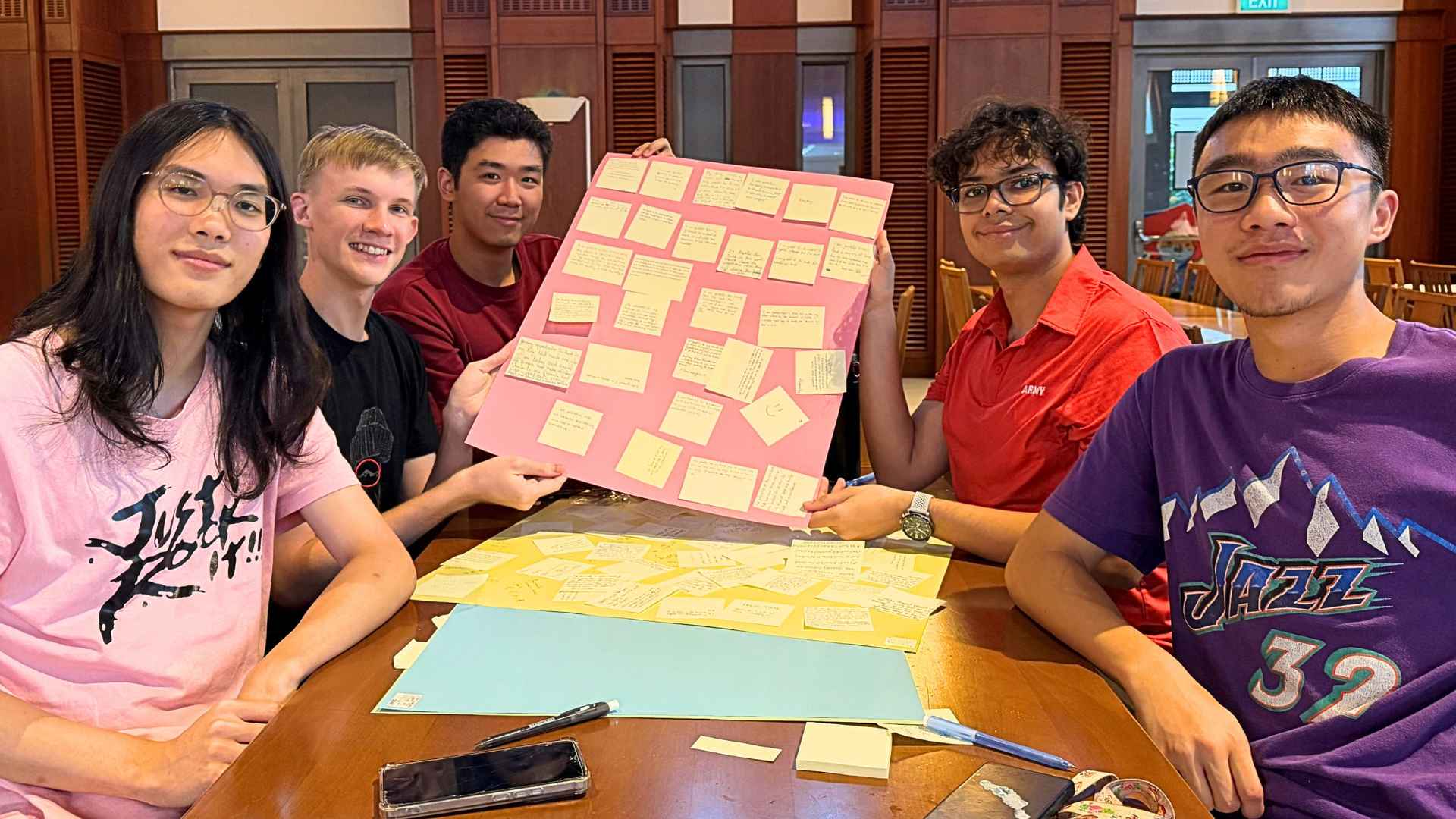 After redistributing their galleries across group tables, each table encounters voices gathered from elsewhere in the room.
In the same vein, Community Conversations cannot manufacture any of the above on its own. This is something that has become increasingly obvious to me as each session approaches its end. For around two hours, the conditions have been thoughtfully arranged: the music, the distances between tables, the prompts, the protected silence, the anonymous slips of paper, the swapping of groups and the invitation to listen before responding. At the end of it all, everybody leaves Saga Dining Hall and the apparatus disappears, as it must. The more consequential question begins afterwards, when nobody is standing at the front of the room instructing anyone to move seats, and students must decide for themselves whether the Elm Buttery, Cendana Courtyard, or the sofas lining the corridors of the faculty offices might still accommodate a conversation that goes somewhere unexpected.
One first-year student expressed the hope that Community Conversations might eventually cease to be something that NUSC has to schedule. Instead, the “permission to be honest” experienced inside the programme would “leak into ordinary corridor conversations”. I suspect that six months from now, what would matter more to me than whether anybody remembers the prompts, would be the continued presence of third spaces. This allows students who are unfamiliar with one another to stop and have an honest conversation, where one’s introversion does not preclude their participation.
When everyone had left, what remained on the tables were the coloured galleries — crowded almost end to end with handwriting that spanned from typewriter-level neatness to what my primary school teacher used to label as “horrible terrible vegetable” illegible. Viewed together, the collective gallery acquired a scale that no individual student encounters during the activity itself: lengthy disclosures sat alongside mischievous remarks, while one-word answers leaned against reflections that have overflowed onto multiple slips. I have come to see that unevenness as part of the record rather than a defect in it. For one brief point in the semester, these sheets contained the living pulse of a cohort still near the beginning of university: already grateful for some things, anxious about others, disagreeing about what deserves to matter and still working out what sort of people they might become around one another.
By the following day, of course, the dining hall had to resume its everyday operations. The more consequential question is whether anything from those two hours followed the students out. Whether, beyond the programme itself, we continue to have community conversations. Aida Lee (Chemical Engineering + NUSC ‘30) put the hope plainly: “I hope everyone feels connected. I wish everyone acknowledges each other.” I have a good feeling that we do.