The second NUS College Impact Festival showcases projects that have evolved, continued across cohorts and created tangible outcomes in Singapore and Southeast Asia
Singapore, 16 September 2026 — Student-led community projects have the potential to create meaningful, sustained impact when given the time and space to take root, evolve and be carried forward. This is what NUS College (NUSC) has witnessed through its Impact Experience (IEx) programme, where students spend two years working alongside communities in Singapore and Southeast Asia to develop projects designed to have long-lasting impact beyond the project duration.
The outcomes of these projects took centre stage at NUSC’s second Impact Festival held on 16 September at NUS University Town.
Projects that began as student initiatives have developed into ongoing community efforts, with some carried forward by subsequent cohorts and continuing beyond the students who started them. These include a bamboo learning centre supporting alternative livelihoods in rural Thailand, community-led ecotourism initiatives in Indonesia and a food-support system for rough sleepers in Singapore.
The two-year trajectory is central to how IEx is designed. It gives students and community partners time to build relationships, understand the challenges they are working on, shape projects together and refine their approaches.
IEx has been a cornerstone of the NUSC curriculum and is recognised internationally, winning a 2025 QS Reimagine Education Award (Silver) under the Sustainability Education: Action category.
Professor Simon Chesterman, Dean of NUSC, said: “We are really proud to see how the Impact Experience has grown over the years. The projects that have emerged from the programme remind us that, in a world where technology is helping us move faster and generate solutions more quickly, meaningful change often takes time. Students need time to build relationships, test ideas and stay engaged over a longer period for their work to grow and continue with the communities and students that come after them. This is what ‘Resonance’ means to us – seeing the work continue to have meaning and impact for years to come.”
Open to the public, the Impact Festival welcomed visitors to explore 57 IEx projects, including a specially curated Creative Showcase featuring over 20 works ranging from illustrations, dioramas to performances and installations.
From bamboo project to community learning centre
What began in August 2024 as an effort to promote bamboo as a native and eco-friendly source of livelihood in Ubon Ratchathani, Thailand, has evolved into a community-grown circular economy for bamboo that continues to operate and expand today.
The team has since held more than 30 workshops involving over 300 participants, with more than 50,000 bamboo fans ordered and at least one villager adopting bamboo as a primary crop. The project is now being developed by the next cohort of NUSC students, who are working with the original team to expand into new markets, including construction.
Lim En Jia, a third-year Political Science major, said: “Bamboobon believes that environmental sustainability and economic empowerment can come hand in hand. We empower farmers through bamboo cultivation, connect local artisans with buyers and promote community spirit through bamboo.”
Redesigning tourism for local communities
To ensure the Poto Tano community remains at the heart of Gili Balu’s growing tourism industry, a group of students partnered with the marine conservation group, Juang Laut Lestari (JARI), to redesign four ecotour programmes. Recognising the community as both stewards and wards of the ocean, this initiative aims to keep the value of tourism local, ensuring that revenues directly benefit and empower local fisherfolk, women and youth.
With four ecotour programmes redesigned and seven snorkel routes mapped, the project which started in August 2024 has since been handed to a new cohort of NUSC students, who are continuing to co-develop the ecotours with the community as new needs and challenges arise.
Nuryanee Anisah, a final-year Business Administration major, said: “One of my biggest takeaways was that sustainability is not just about protecting the environment but also understanding the people whose lives and livelihoods are connected to it. Some of my most meaningful memories were the simplest ones — sitting with the fisherfolk at night, sharing music and stories, and learning about their lives beyond what we could ever learn in a classroom.”
From food distribution to a sustainable support system
The rough-sleeping community is a hidden one in Singapore, existing quietly in the crevices and corners of neighbourhoods across the island. With homelessness comes the uncertainty of the next warm meal and that is where NUSC students have sought to provide some additional support through working with Homeless Hearts of Singapore (HHOS).
The project started in August 2024 with the team spending its first year testing what would work for a community with diverse needs. While ready-to-eat meals were well–received, the meal distribution schedule did not cater well to members of the community with irregular work hours. On the other hand, a follow-on partnership with a bread programme did not meet most rough sleepers’ dietary requirements. Instead of settling for mismatched support, the team consideredthe feedback from the community and eventually partnered with a hawker stall to introduce a meal-token system. Backed by the Young Change Makers grant from the National Youth Council, the initiative has since reached 19 rough sleepers across two funded runs and continues beyond the students’ IEx term, with its progress tracked on Instagram at @nourish2flourishsg. The team is now moving to Near Field Communication (NFC) basedtokens to make token-distribution easier to track and is applying for a fresh grant to fund the next phase — with opening the system to public donations as a longer-term goal.
“Working with homeless people has created in us greater empathy for them. Many of the rough sleepers here are the cleaning uncles that do the dirty work to make the everyday lives of Singaporeans comfortable and yet we do not reciprocate the same grace to them,” said Soh Tze Jen, a third-year Computer Science major.
Continue the conversation beyond the classroom
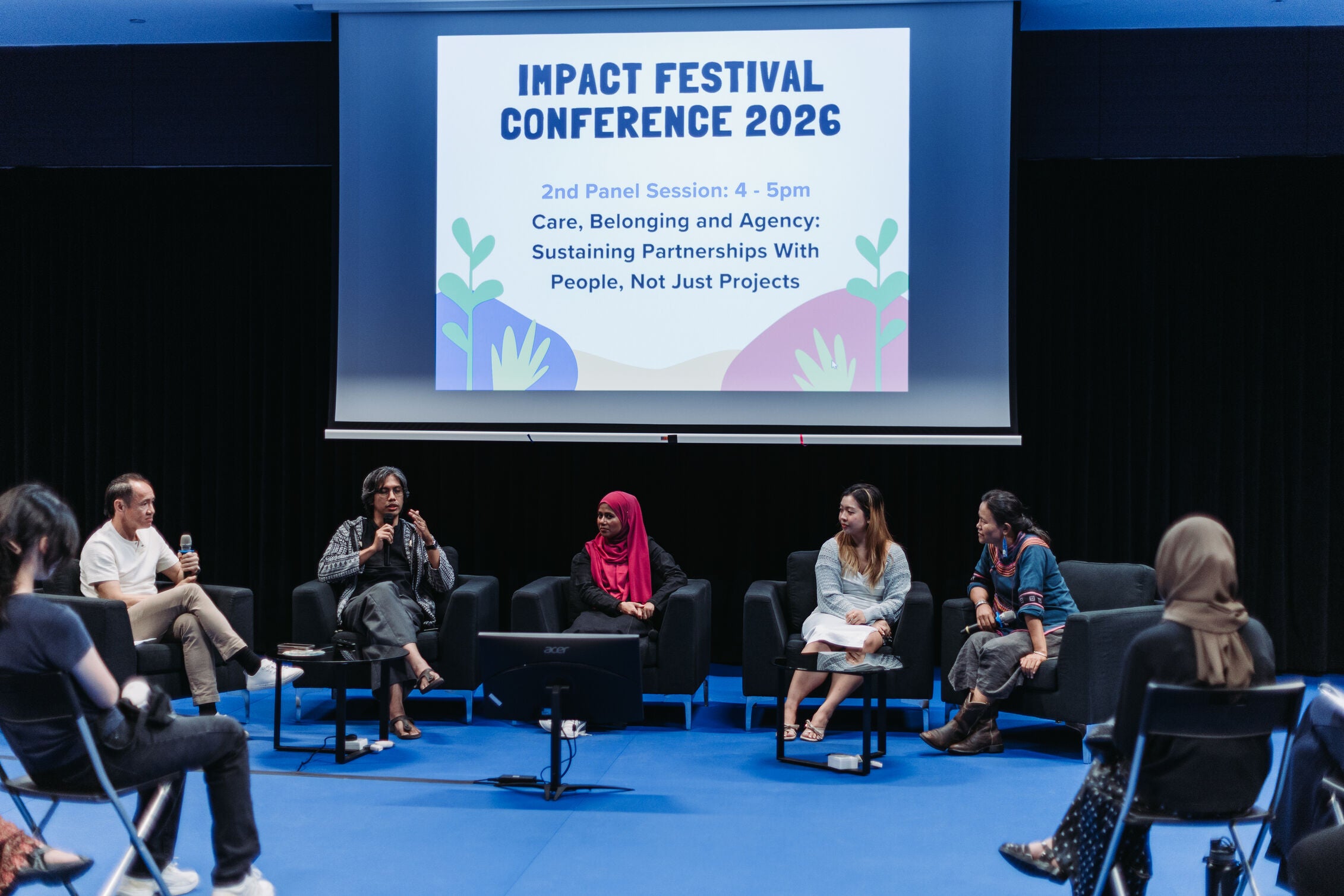
This theme of continuity also anchors a two-part conference at this year’s Impact Festival, bringing together speakers from community groups and organisations across Southeast Asia to discuss how student projects can evolve from short-term interventions into longer-term collaborations and how care, participation and agency can be sustained beyond individual project cycles.
For more information, please visit https://nuscollege.nus.edu.sg/impact-festival/