To shape independent, adaptable thinkers and doers who will make an impact in the world.
The USP education focused on strengthening core academic and professional skills – writing and critical thinking, analytical and quantitative reasoning, the ability to ask the right questions and pursue research, and the habit of reflecting upon ideas within a broad intellectual landscape.
This was achieved through a rigorous multidisciplinary curriculum, as well as a rich offering of local and international programmes. The main focus was on honing core skills that complemented students’ strengths in their major disciplines, thus enabling them to make connections across fields and enhancing their intellectual depth and breadth.
With an expanded worldview and critical thinking capabilities, USP graduates are adept at blending and transcending traditional disciplines, challenging conventional thinking and developing bold and actionable ideas to address complex issues in our changing world.
Defining Attributes of USP
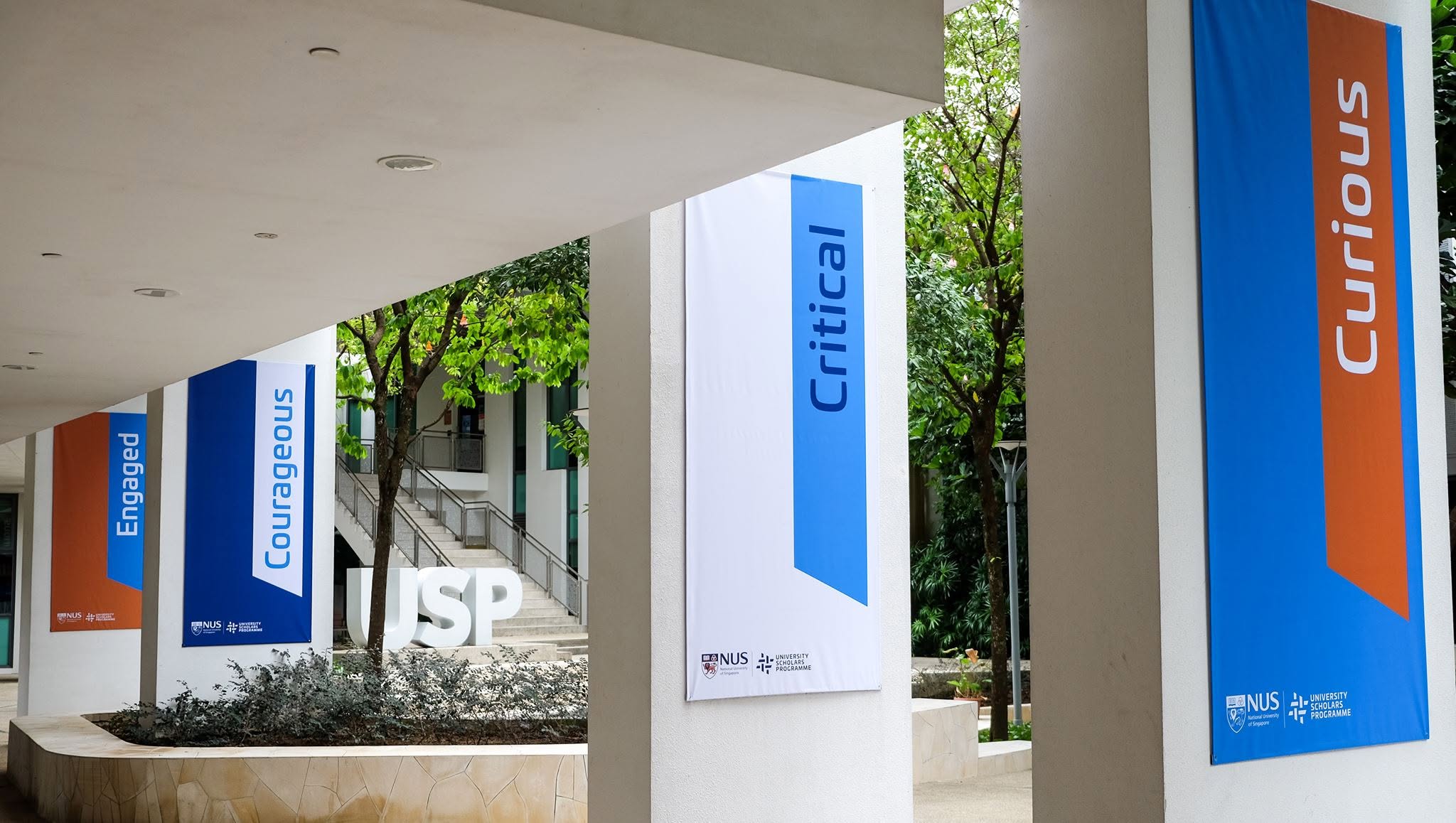
Curious
Adventurous in thought, pursuing a broad range of intellectual interests and ready to make connections across different domains.
Critical
Intellectually rigorous, deeply reflective and having a humility born of awareness of the limitations of our own knowledge.
Courageous
Willing to consider differing points of view, unafraid to face challenges and to act upon ideas.
Engaged
Extends the frontiers of knowledge in energetic and creative ways, prepared to navigate and help shape a complex world in a responsible way.
What did USP mean to the community?
Check out a video produced by former USP Ambassadors Nicholas Cheng (Business Administration + USP ’23), Michelle Phua Kah Hwee (Geography + USP ‘23), Nicholas Lam (History + USP ’22) and Joshua Dass (Business Administration + USP ’25)
Academic Structure
USP placed strong emphasis on designing a curriculum that was truly interdisciplinary for its students from multidisciplinary backgrounds. Twelve USP courses were read in four years, with these courses taken in three structured tiers, namely Foundation Tier, Inquiry Tier and Reflection Tier in a 3+8+1 structure.
3
Foundation Courses
8
Inquiry Courses
1
Reflection Course
Foundation Tier
The foundation modules consisted of the following modules: Writing & Critical Thinking, Quantitative Reasoning, and the University Scholars Seminar.
These modules prepared students for later work in USP by developing foundational skills in reading and thinking critically, using numbers to bolster one’s arguments and reflecting on various modes of inquiry.
Inquiry Tier
The inquiry modules were a structured collection of multi-disciplinary modules that exposed students to two domains in Humanities & Social Sciences (HSS) and Sciences & Technologies (ST).
Reflection Tier
The reflection tier consisted of a single module, the University Scholars Programme Senior Seminar, USR4002. This was designed to bring students together towards the end of their degree to reflect on the conditions of their own disciplinary knowledge and the assumptions developed in the disciplinary framework to approach discourse and ideas.