
By Eyu Kai Jie (Sociology + NUSC ’28).
When the inaugural cohort of NUS College (who joined the College in 2022) gathered for their Commencement ceremony, their guest speaker, local filmmaker Miss Tan Pin Pin, offered a precious gift of perspective. She shared with the Class of 2026 a heartfelt reflection on the quiet, deeply personal act of paying attention to the little details in life and offered practical handles on journeying ahead in our interview with her.
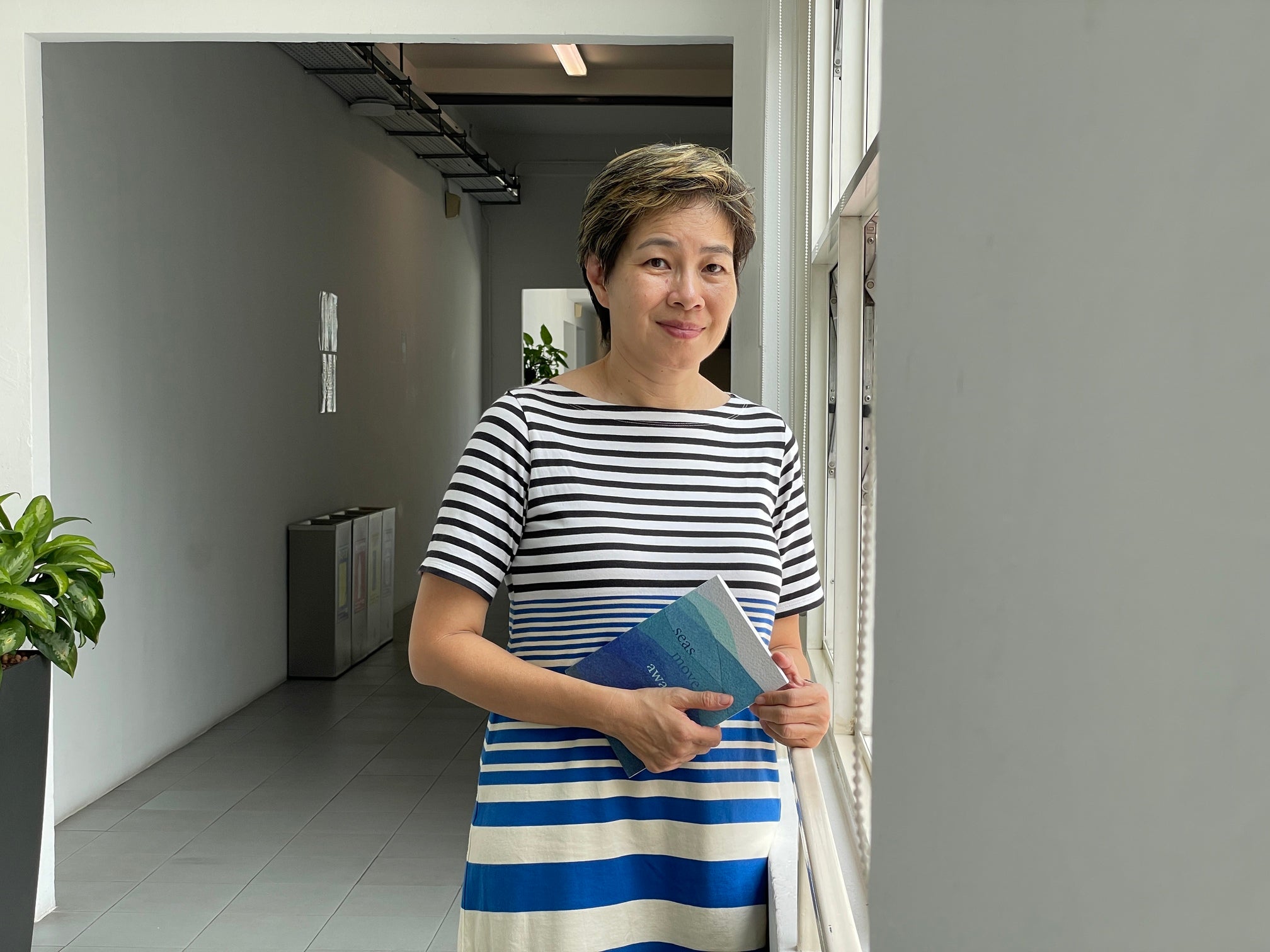 Tan Pin Pin, one of Singapore’s most prominent documentary filmmakers. (Photo: Grace Baey)
As one of Singapore’s most prominent documentary directors, Pin Pin’s own journey to the Commencement stage was not guided by a sleek, well-calculated trajectory. It was the result of a few stubborn choices, countless hours of quiet devotion to her craft – and a willingness to step off what many would consider a lucrative career to become, at one point, a television station gopher.
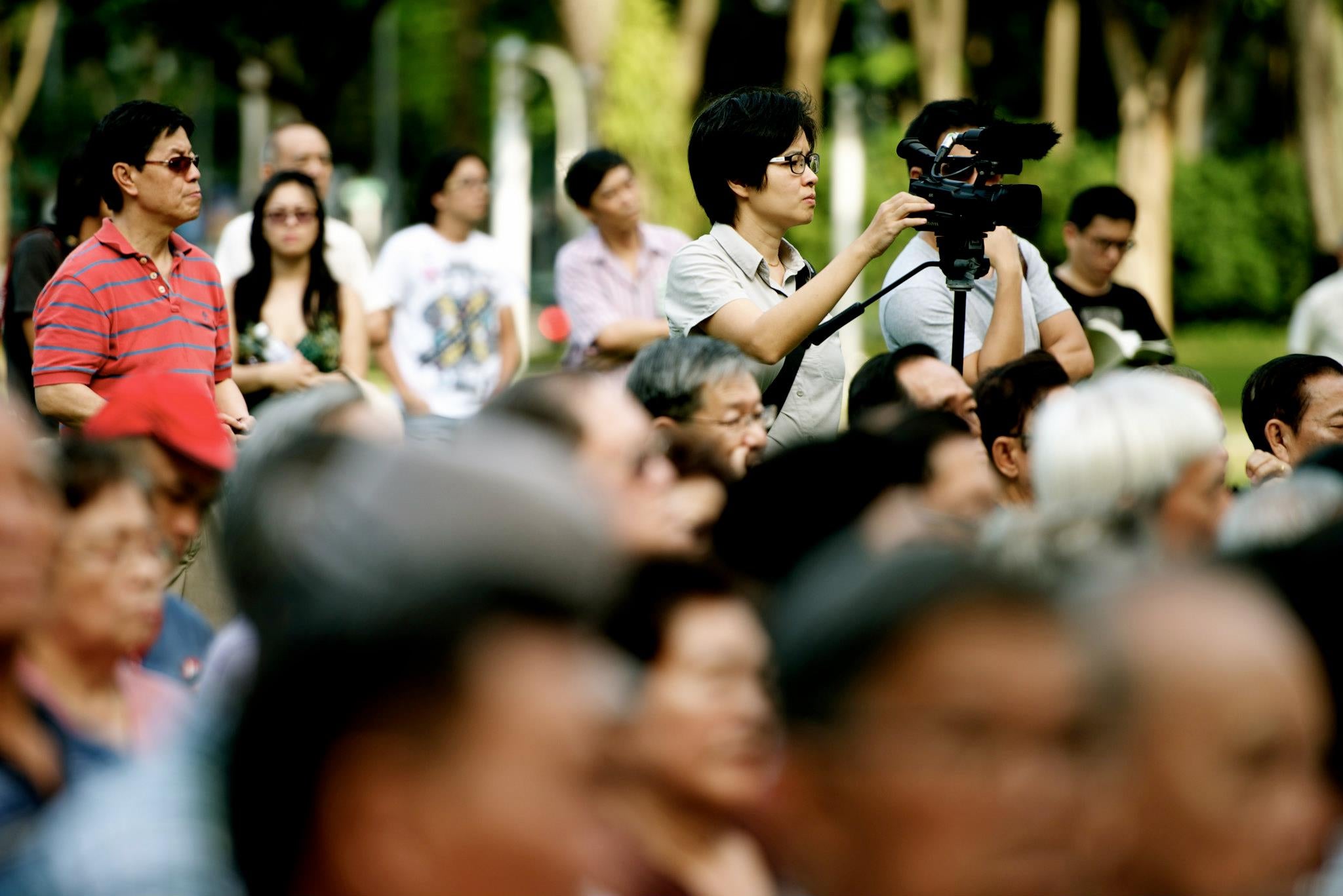 Pin Pin in her element – camera in hand, capturing the world one frame at a time. (Photo: Ho Choon Hiong)
From Law Books to Lenses
Pin Pin’s early path seemed to be perfectly lined up for her, having won the prestigious Loke Cheng Kim Foundation scholarship to study Law at Keble College, Oxford. However, university education has a funny way of introducing unexpected detours. Tucked away in the university libraries, she stumbled upon photography books by Diane Arbus, Henri Cartier-Bresson and Robert Frank. This accidental discovery sparked in her a persistent curiosity about the visual medium that she could not shake off.
Despite her newfound passion, she saw her degree through to the end, honouring the scholarship that had brought her to Oxford. What followed was a delicate balancing act. By day, she worked as a trainee lawyer doing her pupillage; by night, she was busy editing footage and making small independent films on the side.
Her turning point came when she made a grounded observation during her time at the law firm.
“I found myself more interested in cinema than in law. There was so much to learn, I was pouring over magazines, reading books, watching films and also making films. I decided to move towards my area of interest rather than doing it after work only.”
Realising that a conventional career in law was no longer the path for her, she made a radical pivot early on in her career: spending two years in Mediacorp’s English Drama department working as a gopher. It was an unglamorous, ground-level entry into the industry, but it gave Pin Pin the practical exposure she needed before eventually heading to Northwestern University to pursue her Master of Fine Arts.
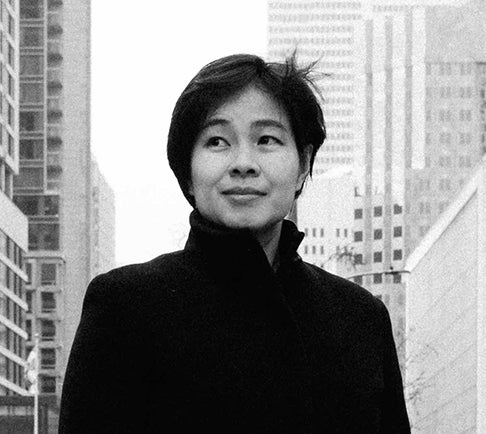 Pin Pin graduated with a Master of Fine Arts from Northwestern University, where she honed her craft in documentary filmmaking. (Photo: Ulysse del Drago)
What We Lose When We Stop Noticing
In her speech during NUSC’s Commencement, Pin Pin drew on a quiet, almost unnoticed shift in Singapore’s urban landscape – one made in the name of progress, yet leaving something irretrievable in its wake. She pointed out how over the last decade, the National Parks Board gradually replaced the city’s old amber sodium streetlights with energy-efficient white LED bulbs.
The policy made perfect sense on paper: the LED bulbs were not only brighter, but also cheaper to maintain. However, the change happened so seamlessly that almost no one noticed that the warm, familiar yellow glow of the city at night was entirely erased from our cityscape. Pin Pin admitted that even she did not notice it until her own street became too bright to sleep in, which is ironic, given that her job revolves around her looking at light.
A central thread in Pin Pin’s speech was the idea that when we lose our memory of the “before,” we lose the foundation of who we are – and with it, our ability to write a story that is true to ourselves. She illustrated this with a personal example: “When I asked my father and uncles – who were educated in English-stream mission schools – about the May 13 riots of 1954, where 1,000 Chinese middle school students took to the streets to protest against the colonial government’s decision to make national service compulsory, they could not recall it as the colonial government suppressed news about these protests so it didn’t reach them at all. The memory of a pivotal moment in Singapore’s history did not register with them. Thankfully, the events were recorded by the students who took part in these protests.” Drawing a parallel to Singapore’s broader landscape, Pin Pin observed that changes have become so gradual and seamless that we risk losing track of these milestones altogether – and with them, our sense of how we came to be.
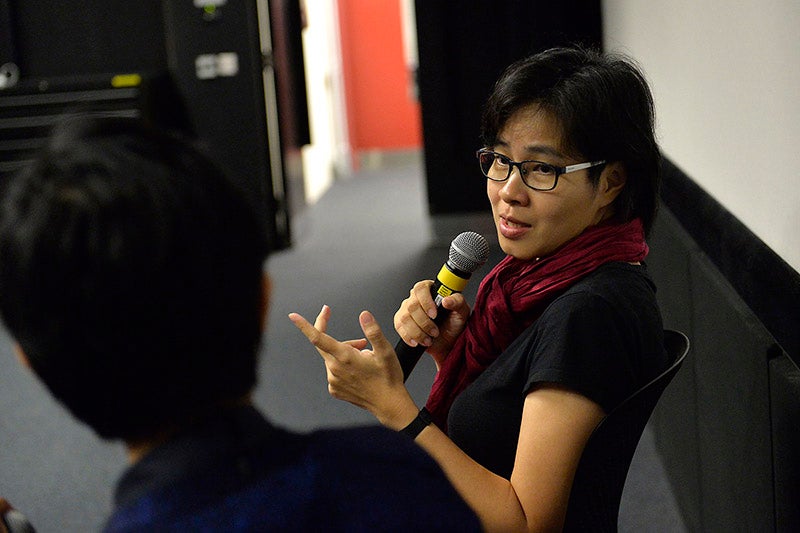 Pin Pin sharing her perspective at a film seminar – a voice for independent storytelling in Singapore. (Photo: Tan Pin Pin)
Advice for the Next Chapter
In our interview, Pin Pin shared a few pragmatic pieces of career advice for the Class of 2026, who are about to step into a world where change is constant, often seamless and difficult to keep pace with:
First, when evaluating opportunities, look beyond the pay cheque. Choose a position where there are opportunities to learn (but may not pay so well). Pay attention to whether the environment nurtures your personal growth and whether good mentors are present – these are the things that will matter far more when you are starting out.
Second, give yourself permission to explore. Take a year or two to test different paths; you won’t truly know the direction you want to head in without actually experiencing it for yourself.
Third, establish a baseline that is yours alone. Before the demands of the working world begin pulling you in all directions, take a moment to write down your current beliefs, hopes and worries. That way, no matter how far life takes you, you will always know where you started.
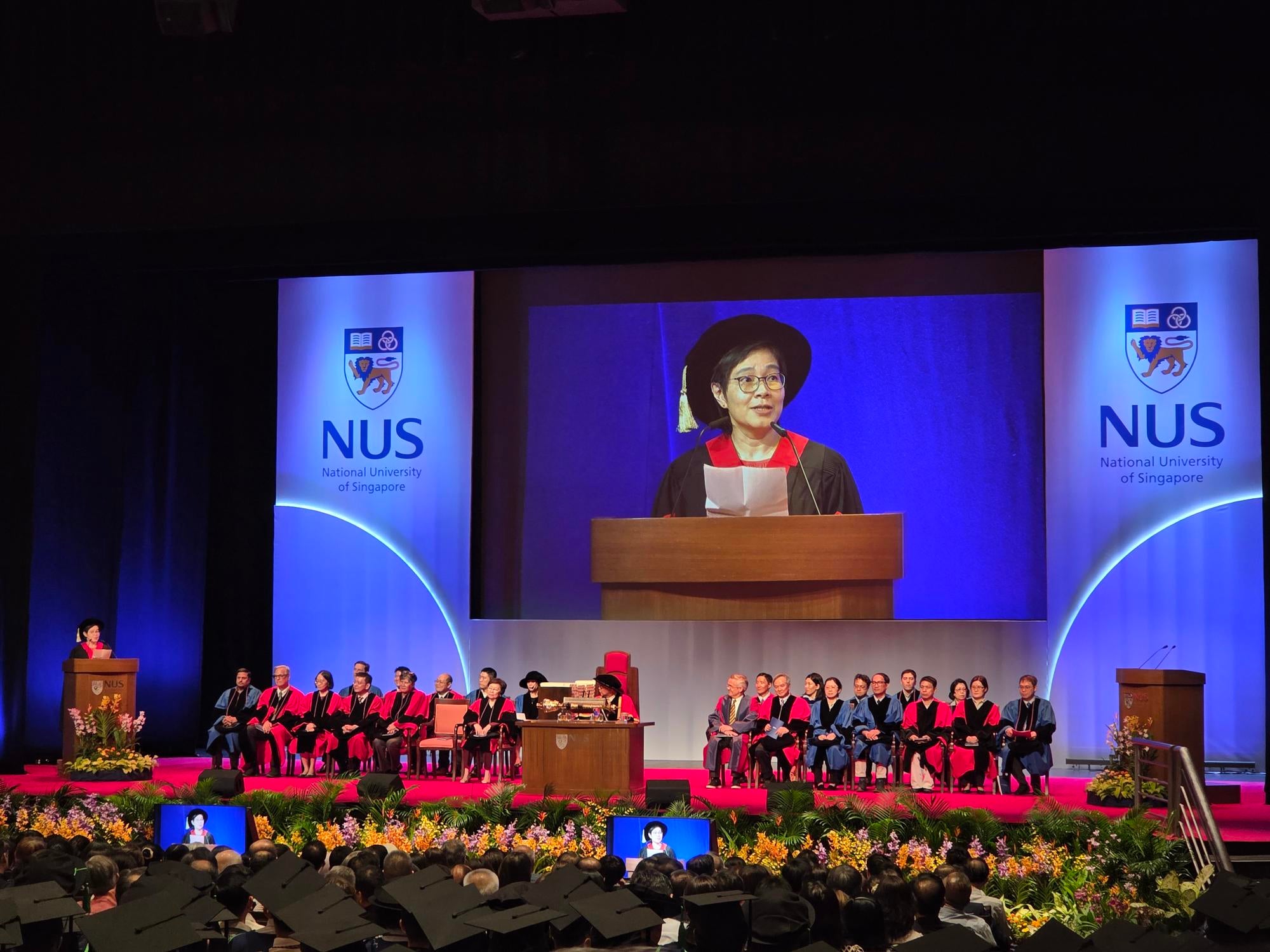 Pin Pin addressing the inaugural NUS College Class of 2026 during their Commencement ceremony. (Photo: NUS College)
As the ceremony drew to a close, Pin Pin left the graduates with a gentle challenge: take a walk around the NUSC campus one last time. Notice the light. Sit down and write an unfiltered journal entry about who you are at this moment in your youth. Because this Commencement marks their baseline, the threshold between the “before” and the “after”. And by holding on to that raw, honest draft of themselves today, they will always have something true to return to as they step into the next chapter of their lives.
Read more about our Class of 2026 graduate stories.